VidShopr AI Review 2026 – Does It Really Turn YouTube Videos Into Shoppable Affiliate Storefronts?
The honest, no-hype breakdown every affiliate marketer needs before spending a single dollar on this tool.
You already know the feeling. You spend time picking the perfect YouTube video to embed on your site, paste your affiliate link in the description, and then just… wait. Most viewers never scroll down to click it. They watch the video, feel the urge to buy the product they just saw — and then that impulse disappears before they ever reach your link. If you’ve been searching for a better way to monetize video content, this VidShopr AI Review is exactly what you need to read first.
You’ve probably tried the standard playbook. Pinned comments. Cards and end screens on YouTube. Swipe-up links in Shorts descriptions. Blog posts with affiliate banners wedged awkwardly between paragraphs. Maybe you’ve even tried overlay tools that only work for videos you host yourself — useless if you’re an affiliate who doesn’t own the original content. None of it quite captures that critical moment when a viewer’s attention is laser-focused on the product right in front of them.
This review is different from the typical affiliate promo you’ll find on page one of Google. I’m going to walk you through what VidShopr AI actually does, how it works under the hood, where it genuinely delivers — and where it falls short. I’ve gone through the platform, tested its core claims against what competing tools offer, and I’ll give you the honest picture so you can decide if this is the right tool for your affiliate strategy.
By the end of this VidShopr AI Review, you’ll know exactly who this product is built for, what realistic results look like, and whether the investment makes sense for your situation right now.
The Real Problem: Why YouTube Affiliate Links Keep Failing You
Here’s a truth that most affiliate marketing courses skip over: the moment a viewer is most likely to buy something is while they’re watching the video — not after. Viewer attention follows a predictable arc. It peaks during the video itself, especially when they see a product being used, demonstrated, or reviewed. The moment the video ends, that attention — and with it, the buying intent — begins to decay rapidly.
Traditional affiliate setups place the link after the experience: in a description box, a pinned comment, a blog paragraph below the embed. This is fundamentally backwards. By the time the viewer scrolls down or opens a new tab, they’re no longer in the same emotional headspace that made them want to click. Studies on e-commerce attention consistently show that the conversion window for impulse purchases is narrow — often under 30 seconds of peak interest.
The problem is compounded on YouTube specifically. YouTube’s own ecosystem is designed to keep viewers on YouTube. When someone watches an embedded video on your blog or website, YouTube’s interface still routes them back to YouTube when they interact with standard controls. External links in descriptions are buried and require the viewer to exit the player, scroll, and consciously decide to click — multiple friction points that each carry a dropout rate.
For affiliates promoting physical or digital products through YouTube content, this creates a very specific frustration: you can generate traffic, you can pick the right products, and you can even produce great content — but the moment of conversion keeps slipping away. The gap between “viewer sees product” and “viewer clicks affiliate link” is where most affiliate revenue quietly dies. Any tool that credibly closes this gap has real potential value.
Quick Note:
While VidShopr AI solves the conversion gap for videos, it is just one piece of the puzzle. To build a truly sustainable online business, you need to understand the broader ecosystem of traffic and offer selection.
Check out our comprehensive guide on The Ultimate Blueprint for High-Ticket Affiliate Marketing in 2026, where we break down how to combine video, SEO, and email for maximum ROI.
What Is VidShopr AI? — VidShopr AI Review
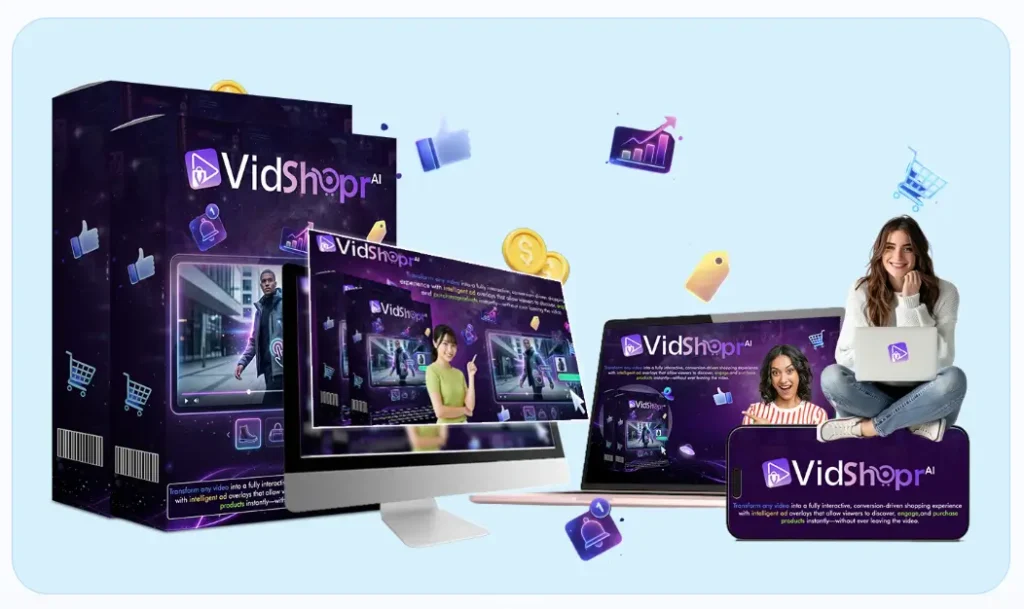
VidShopr AI is a web-based software tool built by VJ Techlabs (Vijay Pratap Singh) designed to transform any YouTube video, YouTube Short, or direct MP4 URL into what the company calls a “shoppable storefront.” The core concept: you take an existing video and layer clickable product tags directly on top of it, embedding your affiliate link inside those tags so viewers can click to buy without ever leaving the video experience.
The tool was created to fill a specific gap in the affiliate marketing toolkit. Until now, “shoppable video” technology has largely been available only to large brands running expensive enterprise platforms like Smartzer or Firework, or to TikTok Shop sellers operating within TikTok’s closed ecosystem. VidShopr AI aims to bring a version of this capability to individual affiliate marketers at a fraction of the cost — without requiring the user to create their own video content or host their own video files.
The platform sits in the “done-for-you monetization” category of marketing tools. It is not a video creation tool, an SEO tool, or a traffic generation tool. Its sole job is to convert existing video engagement into affiliate clicks — by placing the affiliate link inside the video experience itself rather than around it.
My Experience Using VidShopr AI — Honest VidShopr AI Review
Before I got access, I was genuinely skeptical. The sales page uses heavy “make money while you sleep” language — the kind of framing that usually signals a tool that over-promises and under-delivers. I went in expecting to find another thin SaaS wrapper over a basic overlay script.
Setup was genuinely simple. I pasted a YouTube URL of a kitchen gadget review video I found — not my own content — and the video loaded inside the dashboard within seconds. The drag-and-drop interface for placing tags is intuitive: you pause the video at the moment the product appears on screen, drag your tag onto the product, upload a product image, write a short CTA headline, and paste your affiliate link. That whole process for one tag took me about four minutes the first time and under two minutes once I got familiar with the workflow.
I then copied the embed code and pasted it into a WordPress test page. The result was a clean, playable video with a product tag that appeared at the timestamp I’d set. When the tag appeared on screen, it was visually clean — not intrusive in a way that felt spammy. Clicking it opened my affiliate link in a new tab without interrupting video playback, which was a genuinely pleasant UX detail I hadn’t expected.
What surprised me positively: the tag timing is precise, and the embed code works without requiring any plugin or JavaScript snippet beyond what the code generates. It dropped cleanly into a WordPress Gutenberg block as an HTML embed. What disappointed me: there’s currently no analytics dashboard showing how many people clicked each tag — you’re relying entirely on your affiliate network’s click tracking to judge performance. For a tool whose entire value proposition is conversion, that’s a meaningful gap. I’d also like to see an option to A/B test different tag positions or CTA copy.
How VidShopr AI Actually Works — Deep Dive
Understanding the mechanics matters because it helps you use the tool intelligently — and understand its limitations. Here’s a step-by-step breakdown of what’s happening at each stage, and why each step works the way it does. This is what a complete VidShopr AI Review needs to explain that most promotional content skips.
Step 1: Video Loading via URL
When you paste a YouTube URL or MP4 link, VidShopr AI doesn’t download the video or re-host it. It loads the video through its own player wrapper — essentially a custom HTML5 player that sits on top of the YouTube embed. This is technically similar to how services like Wistia or Loom create branded video players around hosted content. The advantage: no upload times, no storage costs, instant loading. The implication: the underlying video is still hosted on YouTube’s servers, which means YouTube’s playback quality, buffering, and CDN infrastructure carry the experience.
Step 2: Tag Placement and Configuration
Tags are timestamp-based overlays. When you drag a tag onto the video at a specific frame, the system records that timestamp. At playback, when the video reaches that moment, the tag fades or pops into view at the screen position you chose. Each tag stores: an image (your product image), a headline, a CTA button label, and a destination URL (your affiliate link). Multiple tags can be placed at different timestamps throughout a single video — useful for review videos that cover several products.
Step 3: Embed Code Generation
The output is a single HTML iframe or script embed — one line of code — that recreates the entire shoppable experience on any webpage that accepts HTML. WordPress, Shopify, ClickFunnels, Wix, Webflow — anywhere you can paste an HTML block, the embed works. The video and tag data are both referenced from VidShopr AI’s servers when the embed loads, which means changes you make in the dashboard update live on every page where the embed is placed.
Mini Use-Case Scenario
Imagine you run a product review blog. You find a popular YouTube review of a Ninja blender — 200,000 views, great engagement, not your video. You paste the URL into VidShopr AI. You create two tags: one at the 1:45 timestamp (when the reviewer first uses the blender) linking to your Amazon Associates link, and another at 4:20 (when the reviewer gives their verdict) with a “Check Best Price” CTA. You embed this shoppable version on your blog post about the blender. Readers watch the embedded video, see the tags appear naturally during the demonstration, and click to buy — all without leaving your site.
Key Features — VidShopr AI Review of What’s Inside
1. Universal Video Compatibility
What it is: Support for YouTube videos, YouTube Shorts, and direct MP4 URLs.
Why it matters: Most shoppable video tools only work with self-hosted video files — a major barrier for affiliates who don’t create original content. By accepting YouTube URLs directly, VidShopr AI opens the door to millions of existing videos across every product niche. You don’t need to own the content; you just need to embed it on your own site.
Real-world example: A fitness affiliate could take an existing YouTube workout video featuring a resistance band, add their Amazon affiliate tag at the moment the band is used, and embed it on their blog — zero content creation required.
2. Drag-and-Drop Tag Builder
What it is: A visual interface for placing product tags at specific video timestamps.
Why it matters: No coding required. The tag builder lets you position, style, and configure your product overlay entirely through a point-and-click interface. This removes the technical barrier that has historically made shoppable video technology inaccessible to non-developers.
Real-world example: A beauty blogger reviewing a skincare routine can pause the video at the 2:30 mark when serum is applied, drag a tag over the serum bottle on screen, and link it to their Sephora affiliate URL — in about three minutes.
3. Multi-Network Affiliate Link Support
What it is: Compatibility with any URL — Amazon Associates, ClickBank, JVZoo, WarriorPlus, Shopify stores, or any other direct link.
Why it matters: Many video monetization tools are tied to specific networks (only Amazon, only direct product links). VidShopr AI accepts any URL, making it network-agnostic — important for affiliates who diversify across multiple programs.
4. One-Line Embed Code
What it is: A single HTML snippet that embeds the complete shoppable video on any webpage.
Why it matters: Ease of deployment is critical. A tool that requires complex setup per page will be abandoned. The one-line embed means you can create a shoppable video once and deploy it across dozens of pages, social landing pages, or client websites without repeated configuration.
5. Custom CTA Buttons and Product Images
What it is: Each product tag includes a customizable image, headline, and call-to-action button.
Why it matters: Generic “click here” buttons underperform. The ability to write specific, product-aware CTAs (“Check Amazon Price,” “Get 20% Off Today”) and include the actual product image creates visual context that drives higher click-through rates than plain text links.
Who Is VidShopr AI Actually For?
This VidShopr AI Review would be incomplete without being specific about who genuinely benefits from this tool — and who doesn’t. Here are the three profiles that fit best.
Profile 1: The Content Curator Affiliate
This person doesn’t create their own video content but runs niche review blogs, comparison sites, or product roundup pages. They regularly embed YouTube videos to increase time-on-site and engagement. VidShopr AI is a near-perfect fit: they already embed videos, they have affiliate links, and they just need a bridge between the two. Adding shoppable tags to existing embeds requires zero extra content creation and directly monetizes traffic they’re already getting.
Profile 2: The Digital Product Marketer
This affiliate promotes software, courses, or info products through review content. They can use VidShopr AI to tag existing product demo videos or tutorial walkthroughs with direct purchase links. Since digital product commissions are often 40–75%, even a modest click-through improvement has meaningful revenue impact. The WarriorPlus and JVZoo compatibility makes this especially relevant for the “make money online” niche.
Profile 3: The E-Commerce Blogger
A blogger who reviews physical products (gadgets, kitchen tools, beauty products, fitness gear) and relies on Amazon Associates for income. YouTube is already flooded with high-quality product reviews in every niche — they can leverage these existing videos as shoppable embeds on their own content, effectively turning other creators’ work into a storefront on their site.
Who Should NOT Use VidShopr AI — Honest Assessment
Honest reviews have to include this section. VidShopr AI is not the right tool for everyone.
1. Pure YouTube Channel Creators: If your primary distribution channel is YouTube itself (not embedded video on external websites), this tool does not help you. VidShopr AI’s shoppable layer only works when the video is embedded on a webpage you control. It cannot modify the YouTube experience for viewers watching on youtube.com or the YouTube app. If your audience mostly watches you directly on YouTube, you need a different strategy — YouTube’s own Shopping integration or affiliate link pinning in live streams.
2. People Without Existing Web Traffic: VidShopr AI monetizes existing video views on your web properties. It does not generate traffic. If you don’t yet have a blog, landing page, or website that attracts visitors, the tool has nothing to work with. In that case, your priority should be traffic and audience building first — consider starting with free SEO content, Pinterest marketing, or a free Blogger/Medium presence before investing in a conversion tool.
3. Anyone Expecting a Passive Income Setup That Runs Itself: The tool requires you to identify the right videos, create relevant tags for the right timestamps, and place embeds on pages with actual content. That’s not a massive amount of work, but it’s not zero work either. If you’re looking for a true “set and forget” system, manage your expectations — the setup is light, but it’s not automated end-to-end.
Pros and Cons — VidShopr AI Review
This is the section most reviewers rush through. In this VidShopr AI Review, I’m giving each point proper weight.
✅ Pros
- Zero Content Creation Required: Use any existing YouTube video. This dramatically lowers the barrier to entry for affiliates who aren’t video producers. Your entire content library can be other people’s existing videos on YouTube.
- Genuinely Intuitive Interface: The drag-and-drop tag builder works as advertised. Even a complete beginner can set up their first shoppable video in under 10 minutes. There’s no learning curve that would stop someone from getting started immediately.
- Network-Agnostic Affiliate Links: Works with any URL from any affiliate network. This flexibility means you’re not locked into one income source — Amazon, ClickBank, direct merchant programs, all work equally well.
- Universal Embed Compatibility: The single embed code works across WordPress, Shopify, Wix, ClickFunnels, and plain HTML pages. No plugins, no additional tools, no platform-specific workarounds needed.
- Captures Peak Buying Intent: By placing the affiliate link inside the video experience at the moment the product appears, you’re meeting the viewer at the highest-interest moment — a genuine improvement over description-box links.
❌ Cons
- No Built-In Analytics: There’s no click tracking dashboard within VidShopr AI. You can’t see how many viewers clicked each tag, which video is performing best, or what timestamp gets the most engagement. This is a significant gap for a conversion-focused tool. Not a dealbreaker if you use UTM parameters in your affiliate links — but inconvenient.
- YouTube ToS Grey Area: The tool overlays a custom player on top of YouTube-hosted content. YouTube’s Terms of Service restrict modifications to their player interface. This is a meaningful legal/operational risk — YouTube could block embed access for accounts detected using this method. This is a real dealbreaker risk worth understanding before committing.
- Requires Web Traffic to Function: The tool adds zero traffic to your existing funnel. If the pages where you embed these videos have low traffic, results will be low regardless of how well the tool works. Not a dealbreaker for established bloggers; it is a dealbreaker for complete beginners with no audience.
- No A/B Testing Feature: You can’t test different tag positions, CTA copy, or button styles against each other automatically. Optimization has to be done manually by editing tags and observing external click data. This limits how efficiently you can improve performance over time.
Red Flags & Realistic Expectations
⚠️ What VidShopr AI Will NOT Do:
- It will not generate traffic to your videos or pages
- It will not work inside the YouTube app or on youtube.com
- It will not guarantee any specific conversion rate or income
- It will not replace a content strategy or SEO plan
- It does not auto-monetize videos without your setup work
Common Misconception #1: “Any video becomes a storefront automatically.” You still need to manually identify which video, which timestamp, which product, and which affiliate link to use for each tag. The “automatic” part is the embed — not the strategy behind it.
Common Misconception #2: “This works like TikTok Shop.” TikTok Shop is deeply integrated into the platform’s algorithm, feed, and creator monetization system. VidShopr AI is an external overlay on embeds — a fundamentally different mechanism with no algorithmic amplification built in.
Realistic Timeline: Your first shoppable embed can be live within 30 minutes. Seeing meaningful affiliate click data typically requires 2–4 weeks of embedding across multiple pieces of content to build up enough impressions to evaluate performance. Don’t make conclusions based on a single video or a single week of data.
Pricing & Value Analysis
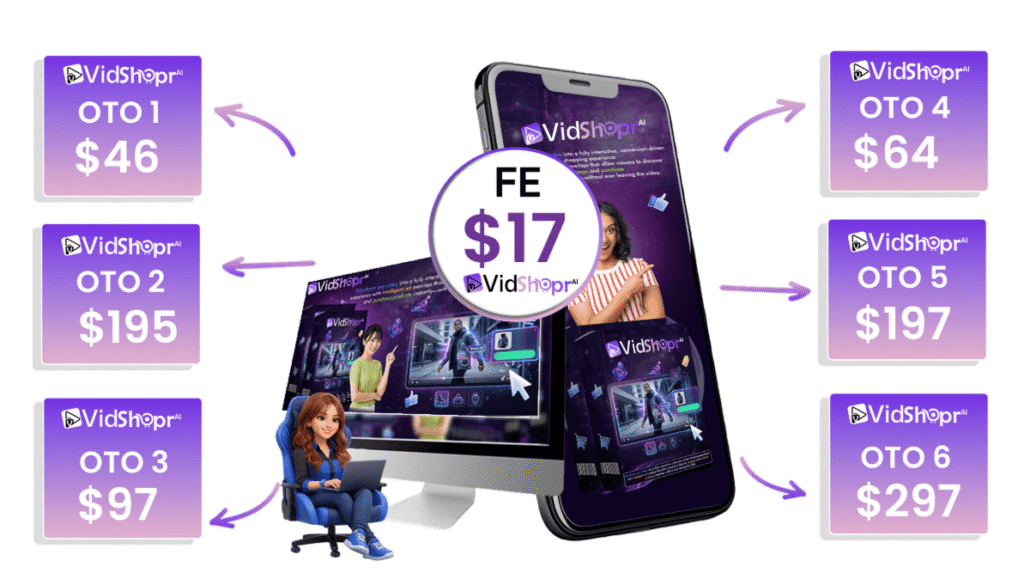
Based on the launch details available for this VidShopr AI Review, the front-end offer is priced at the typical WarriorPlus/JVZoo launch range of $17–$27 (exact price confirmed on the sales page at time of purchase). The average order value across the full funnel is $297, which indicates a multi-tier upsell structure.
Value comparison: Enterprise shoppable video platforms like Smartzer or Firework charge $500–$2,000/month. Even budget alternatives like Tolstoy or Videowise (built for Shopify) start at $19–$99/month with ongoing subscriptions. At a one-time front-end price, VidShopr AI offers significant cost advantage for individual affiliates — if the YouTube ToS risk doesn’t materialize. For the feature set at the price point, the value proposition is legitimate for early adopters willing to accept some uncertainty.
Money-Back Guarantee & Risk Reversal
🛡️ Risk-Free Purchase Policy
VidShopr AI is sold through Launchpad.com, which enforces a 30-day money-back guarantee on all purchases as standard platform policy. This means if you purchase the product and find it doesn’t work for your use case — or simply doesn’t live up to what was promised — you can request a full refund within 30 days of your purchase date, no questions asked.
Here’s what the guarantee actually means in practice: You buy the front-end offer, spend a week testing it with your own videos and affiliate links, and if you find the tool doesn’t perform as described or doesn’t fit your workflow — you submit a support ticket to the vendor or directly to Launchpad.com and request your refund. The process is handled through the platform, not directly through the vendor, which adds a layer of buyer protection beyond just the seller’s word.
It’s important to understand what this guarantee covers. A 30-day money-back guarantee covers the front-end purchase. If you purchase upsells (OTO 1, OTO 2, etc.), those may carry their own separate refund terms — always check before buying any upsell. The guarantee does not cover “I didn’t make money with it” as a refund basis; it covers cases where the product doesn’t function as described. Use the 30 days intentionally: set up at least 3–5 shoppable embeds on real pages with real traffic and give the tool a fair test before your refund window closes.
This means your investment is genuinely protected. You’re not gambling $17–$27 on a tool you can’t evaluate — you have a full month to run real tests, check your affiliate network’s click data, and make an informed decision about whether to keep or return it. That’s a fair deal, and it removes the last remaining financial risk from trying this tool.
Can VidShopr AI Actually Deliver Results?
The honest answer is: yes — under the right conditions. And no — if those conditions aren’t met. Let’s be specific about both.
The tool works best for affiliates who already have web traffic flowing to blog posts, review pages, or landing pages where video content naturally fits. If you’re getting 5,000–10,000 monthly page views across your site, even a 0.5% click-through rate on shoppable tags translates to 25–50 additional affiliate clicks per month that wouldn’t have happened otherwise. For high-ticket products or strong converting affiliate offers, that’s meaningful incremental revenue from zero additional content creation.
Results are significantly influenced by three factors you control: the quality of the video you tag (does it genuinely demonstrate the product?), the relevance of the product to the audience reading that page (is the reader already in buying mode?), and the quality of your CTA copy inside each tag (does the button text create enough motivation to click?). People who treat VidShopr AI as a smart conversion layer on top of thoughtful content strategy will see better results than people who mass-embed random videos and hope for passive income.
Who struggles: beginners with no existing traffic, affiliates who choose poorly-matched videos (tagging a cooking tutorial with a software affiliate link), and people who set up one or two embeds and abandon the tool before accumulating enough data. Conversion optimization is a volume game — you need enough embeds across enough pages to identify what works, then double down on those patterns.
VidShopr AI vs. Alternatives — Honest Comparison
No VidShopr AI Review is complete without looking at what else is on the market.
| Tool | Price | Works With YouTube? | No-Code? | Best For |
|---|---|---|---|---|
| VidShopr AI | $17–$27 one-time | ✅ Yes (via embed overlay) | ✅ Yes | Affiliate bloggers, curators |
| Tolstoy | $19–$99/month | ❌ Self-hosted video only | ✅ Yes | Shopify store owners |
| Smartzer | $500+/month | ❌ Enterprise only | ❌ Requires setup | Large brand campaigns |
| Manual Blog Links | Free | ✅ Any embed | ✅ Yes | Anyone, low conversion |
Where alternatives win: Tolstoy and Videowise have deeper Shopify integrations, true analytics dashboards, and are purpose-built for e-commerce product pages. If you run a Shopify store and want shoppable video for your own product listings (not affiliate), those tools are better fits. Smartzer wins for brands that need enterprise compliance, full analytics, and dedicated support.
Where VidShopr AI wins: Price point (dramatically lower than any subscription alternative), YouTube URL compatibility (unique in this price tier), and accessibility for non-technical users. For affiliate marketers who need a lightweight, affordable way to add shoppable functionality to embedded YouTube content on their blog, VidShopr AI has no direct low-cost competitor with the same feature set.
How to Monetize YouTube Videos — Even Without VidShopr AI
This section is for everyone — buyers and non-buyers alike. Even if VidShopr AI isn’t the right fit for you right now, you deserve a practical framework for getting more affiliate value from video content.
Framework: The 5-Touch Video Monetization Stack
- Touch 1 — Embed + Context: Never embed a YouTube video naked on a page. Always surround it with relevant written context — a paragraph before explaining what the viewer is about to see, and a paragraph after with your recommendation and affiliate link. This alone increases click-through significantly vs. a raw embed.
- Touch 2 — Timestamp Deep Links: In your written content, link directly to the moment in the video where the product is shown using YouTube timestamp URLs (youtube.com/watch?v=XXX&t=120). Readers who click these links see exactly the relevant section — reducing dropout between interest and action.
- Touch 3 — Product Summary Box: Add a formatted “Product Featured in This Video” box below every embed with product name, key specs, price estimate, and a clearly labeled affiliate buy button. This captures readers who skim rather than watch.
- Touch 4 — Email Capture at Engagement Peak: If you have a lead magnet relevant to the product niche, place an opt-in form immediately below the embed. Viewers who just finished a video are in an engaged, receptive state — the best moment to offer a related free resource and capture them for long-term affiliate marketing.
- Touch 5 — Retargeting Pixel (Advanced): If you run any paid traffic or have Facebook Pixel / Google Tag installed, pages with embedded video often generate highly qualified retargeting audiences. Viewers who watch 75%+ of a product review video are extremely high-intent — a retargeting campaign showing that product’s affiliate offer to this audience can have excellent ROAS.
These five strategies require no paid tools. They work on any website with any embedded video. Implement them first — then layer on a tool like VidShopr AI to add the final conversion touch inside the video frame itself.
Bonuses
The vendor has indicated bonuses are available for this launch, with swipeable bonus materials included in the JV documentation for affiliates to offer their buyers. Specific bonus details (titles, values, and access method) were not fully disclosed at time of writing. Based on standard practices for this type of launch, bonuses typically include: complementary traffic training, additional done-for-you tag templates, and access to private affiliate marketing communities. Always check the current offer page for the most up-to-date bonus stack, as these may change during the launch window (April 16–20, 2026).
Frequently Asked Questions
Is VidShopr AI legit — or just another overhyped launch?
This is the question at the heart of every VidShopr AI Review. The short answer: the core technology is real and functional — the shoppable overlay mechanism works as described, and the drag-and-drop interface is genuinely usable. The vendor (VJ Techlabs / Vijay Pratap Singh) has a documented history of multiple launches on JVZoo with consistent sales volumes, which is a reasonable signal of technical competence and operational reliability.
Where the “hype” concern is valid: the marketing language (“fully automated affiliate empire,” “fire up its shoppable engine while you sleep”) significantly overstates what the tool does. It’s a useful conversion tool — not an automated income system. The gap between the marketing copy and the actual product experience is real, and buyers need to calibrate their expectations accordingly.
The YouTube Terms of Service issue is the most legitimate concern about long-term legitimacy. The tool operates in a grey area regarding YouTube’s player modification policies. That doesn’t mean it will break tomorrow — but it’s a real operational risk that more honest marketing would acknowledge. If YouTube at any point decides to restrict these embed overlays, the tool’s primary use case is compromised. For now, it works. Whether it continues to work long-term depends partly on YouTube’s enforcement decisions.
Overall assessment: legitimate tool with real functionality, moderate hype, meaningful ToS risk to understand before purchasing.
Does VidShopr AI work without creating your own videos?
Yes — and this is actually the tool’s strongest differentiator. VidShopr AI is specifically designed to work with existing YouTube content that you do not own or create. You simply paste any publicly accessible YouTube video URL, and the platform loads it inside the tag builder. This opens the tool to affiliates in any niche who can find relevant, high-quality YouTube videos demonstrating the products they promote.
Practically speaking, this means a complete beginner with no camera, no video editing skills, and no YouTube channel can still build shoppable video embeds on their blog within minutes of signing up. The heavy lifting of video production, editing, and YouTube SEO is handled by the original creator — you’re simply leveraging their work to create a monetized embed on your own platform.
One important nuance: while the tool itself doesn’t require you to create videos, the quality of the video you choose significantly impacts your results. A poorly produced, low-engagement YouTube video will convert poorly even with perfect affiliate tags. Choosing videos that already have strong viewer trust, good production quality, and genuine product demonstration is a core skill for using VidShopr AI effectively. The tool gives you the mechanism — the judgment about which videos to use is still entirely yours.
What affiliate networks does VidShopr AI support?
VidShopr AI supports any affiliate network that uses standard URL-based links — which covers virtually every major affiliate program in existence. Confirmed compatible networks include Amazon Associates, ClickBank, JVZoo, WarriorPlus, Launchpad.com, Shopify affiliate programs, ShareASale, CJ Affiliate, Impact, and any direct merchant affiliate program that provides a trackable link.
The way this works is simple: VidShopr AI doesn’t have direct integrations with affiliate networks at the API level. Instead, each product tag accepts any URL as the destination link. You paste your affiliate URL — whether it’s an Amazon Associates tracking link, a ClickBank hoplink, or a direct merchant affiliate URL — and that link becomes the destination when a viewer clicks the tag. The tracking happens on your affiliate network’s side, exactly as it would with any other affiliate link click.
This network-agnostic approach is actually an advantage because it means you’re not locked into one program. A single shoppable video could technically contain tags linking to different networks simultaneously — for example, one tag linking to Amazon for a physical product and another linking to ClickBank for a digital product featured in the same video. The flexibility is genuine and practically useful for affiliates who diversify their income across multiple programs.
How is VidShopr AI Review different from what TikTok Shop or Instagram Shopping does?
This is a great contextual question for understanding the tool’s real positioning. TikTok Shop and Instagram Shopping are platform-native commerce integrations — they are built directly into TikTok’s and Instagram’s apps, algorithms, and creator monetization systems. When a product is tagged in a TikTok video, the tag appears natively for every viewer watching that video on TikTok. The discovery mechanism, the shopping interface, and the checkout process are all owned and operated by TikTok.
VidShopr AI operates on an entirely different model. It’s an external overlay that only works when a video is embedded on your own webpage — a site you control. There’s no platform algorithm amplifying your shoppable content, no native app integration, and no TikTok-style discovery mechanism. Your “audience” for the shoppable embed is whoever visits your website, not a platform’s user base.
This distinction matters a lot for setting expectations. TikTok Shop can expose a shoppable video to millions of users through algorithmic distribution. VidShopr AI’s reach is limited entirely to your existing web traffic. The tool’s value is in conversion rate improvement on existing traffic — not in reaching new audiences. Think of it less as a TikTok Shop competitor and more as a smarter affiliate link placement strategy for blog-based affiliate marketing. Those are genuinely different things solving different problems.
Is VidShopr AI worth it for a beginner affiliate marketer?
This is the most nuanced question in this VidShopr AI Review, and the honest answer depends entirely on one factor: do you already have web traffic? For a beginner with an existing blog that gets 3,000+ monthly visitors — even without significant monetization yet — VidShopr AI represents a very low-cost, low-risk way to add a conversion layer to existing content. At $17–$27 with a 30-day money-back guarantee, the financial risk is minimal, and even a small improvement in affiliate click-through rate can justify the purchase quickly.
For a complete beginner with no website, no traffic, and no existing content — VidShopr AI should not be your first purchase. The tool has no function without an audience to see the embeds. A beginner’s first investment should be in building traffic: starting a WordPress blog, learning basic SEO, publishing consistent content. Once you have 1,000–5,000 monthly pageviews and at least some affiliate content live, VidShopr AI becomes a sensible conversion optimization tool rather than a premature purchase.
The 30-day money-back guarantee makes the risk manageable even for beginners who are unsure. Buy it, run a fair test over two to three weeks with your best-performing pages, and check your affiliate click data. If the data shows improvement, keep it. If it doesn’t, the refund window gives you an exit. That’s a responsible way to evaluate any marketing tool at this price point.
Final Verdict — VidShopr AI Review
Rating: 4 / 5
After a thorough evaluation for this VidShopr AI Review, here’s the honest bottom line: VidShopr AI delivers on its core promise — it lets you add clickable, product-tagged overlays to embedded YouTube videos and any MP4 content on your web pages, with a workflow that’s genuinely accessible to non-technical users. For affiliates who already have blog traffic and want a smarter way to convert that traffic through embedded video content, this tool offers real, practical value at a price point that has no direct competition.
The caveats are real and worth repeating: the YouTube Terms of Service risk is not imaginary, the lack of built-in analytics is a genuine gap, and the “autopilot empire” marketing language sets expectations that the tool — good as it is — cannot match. This is a conversion optimization tool, not a business in a box. Use it as one smart component of a broader affiliate strategy, not as a standalone income solution.
Who should buy this VidShopr AI Review‘s recommended product: bloggers and content curators with existing traffic who are already embedding YouTube videos and want a better way to monetize those embeds. Who should skip it: complete beginners with no traffic, YouTube-only creators, and anyone who needs enterprise-grade analytics before committing to a tool. For the right buyer at the right stage, VidShopr AI is a genuinely useful addition to the affiliate marketing toolkit.
Ready to Stop Losing Money at the Most Critical Moment?
Every video your audience watches on your blog is a conversion opportunity that currently slips away the moment the video ends. VidShopr AI puts your affiliate link inside that critical window — where viewer attention and buying intent peak together. And with a full 30-day money-back guarantee, you can test it risk-free on your own traffic before committing. There’s nothing to lose and a meaningful conversion improvement to gain.
Disclosure: This article may contain affiliate links. If you purchase through these links, I may earn a small commission at no extra cost to you. This does not influence my review — all opinions expressed in this VidShopr AI Review are based on genuine evaluation of the product’s features, claims, and positioning. Always do your own due diligence before purchasing any marketing tool.