GroxLab AI Review: Does It Really Give You Lifetime Grok AI Access With No Monthly Fees — or Is It Just Another Overhyped Tool?
By Biraj Digital | digitalprousa.com | Last Updated: April 2026
I’m Biraj Digital, an independent digital product reviewer at digitalprousa.com. Over the past 5+ years, I’ve reviewed 100+ AI tools, SaaS products, and digital marketing software across JVZoo, Launchpadjv and WarriorPlus. My job is simple: test it honestly and tell you the truth — good or bad.
Introduction
If you’ve been searching for a GroxLab AI review, chances are you already know the pain of juggling multiple AI subscriptions that drain your wallet every single month. This GroxLab AI review is going to answer the one question that actually matters: is this worth your money, or is it another launcher-day hype product that disappoints after purchase?
You’ve probably already tried ChatGPT. Maybe you even paid for the Plus plan. And yet — you’re still here, looking for something better, something more cost-effective, or something that gives you access to xAI’s Grok without the recurring fee. That’s not a coincidence. Most tools either cap your usage, charge monthly, or lock the best features behind expensive enterprise tiers.
I’m Biraj Digital. I review digital tools for a living at digitalprousa.com. I don’t get paid to say nice things — I get trusted because I say honest things. I tested GroxLab AI during its pre-launch period, went through the full funnel, poked around every feature I could access, and I’m going to give you the full picture — including the one thing that almost made me close the tab.
In this full review you’ll get: a plain-English breakdown of what GroxLab AI actually does, an honest walkthrough of my personal experience, a feature-by-feature analysis, a clear pricing breakdown across all 10 OTOs, who should buy it and who should walk away, and my final verdict based on real usage — not guesswork.
Table of Contents
Understanding the Core Problem: Why AI Subscription Costs Are Crushing Independent Creators
Here’s the reality no one talks about openly: the AI revolution has created a subscription trap. If you want to use ChatGPT at full capacity, that’s $20/month. If you want Claude Pro, that’s another $20/month. If you want Google Gemini Advanced, add another $20/month to that. And if you’ve been eyeing Grok — xAI’s AI system built by Elon Musk’s team — the SuperGrok plan runs $30/month or $300/year.
Stack those together for a serious content creator or marketer and you’re looking at $80–$100/month just to stay competitive with AI tools. For a full-time professional, that might be justified. But for the majority of WarriorPlus and JVZoo buyers — affiliate marketers, small business owners, solopreneurs, side hustlers — that monthly bleed adds up to $960–$1,200/year, and most of them aren’t seeing $1,200 worth of return on that spend.
The free alternatives look attractive on the surface but have hard walls. Free ChatGPT throttles you after heavy usage, Grok free tier limits you to basic models, and many tools restrict API access unless you’re on enterprise plans. The result: people constantly toggle between tools, lose workflow, waste time, and still feel like they’re not getting full value.
What does someone who’s actually solved this problem look like? They have ONE centralized AI workspace. They pay once, not monthly. They access multiple AI models — including advanced reasoning models — from a single dashboard. They’re not thinking about subscription renewals, they’re focused on output. That’s the gap GroxLab AI is attempting to fill.
Looking for more ways to solve your digital problems? If you need more AI-powered solutions, productivity hacks, or marketing software, we’ve got you covered. Explore our comprehensive hub of tools designed to streamline your workflow.
What Is GroxLab AI?
GroxLab AI is a web-based AI dashboard that gives you one-time access to xAI’s Grok AI models — including multiple versions of Grok — under a single lifetime license. It was created by Peter Onwe and launched on WarriorPlus on April 25, 2025.
The core claim of this GroxLab AI review product is straightforward: instead of paying $30/month for SuperGrok directly through xAI, you pay a one-time fee of $14.95–$23.95 and get ongoing access to the same Grok models via GroxLab’s platform — including what they describe as Grok 3 series models and upcoming versions.
What category of solution is it? It’s a one-time purchase SaaS tool — a third-party wrapper/dashboard built on top of xAI’s Grok API. You’re not buying from xAI directly; you’re buying access through GroxLab’s system, which handles the API layer for you. For non-technical users, this is actually an advantage — no API keys to manage, no developer setup, just log in and start using it.
What makes it different from similar tools? The main differentiator is the pricing model. Instead of monthly, it’s lifetime. And instead of just one Grok model, the platform offers access to multiple Grok model versions from a single dashboard — making it a compelling option for anyone who wants to consolidate AI spending.
My Experience Using GroxLab AI
Before testing GroxLab AI, I was in a familiar situation: using ChatGPT Plus for content writing and Grok free tier when I wanted a second opinion or a more unfiltered response on tech topics. The monthly cost was adding up, and I was curious whether a lifetime deal could genuinely replace at least one of those subscriptions.
Onboarding was smooth. After purchase, I got immediate access to the dashboard. The interface was clean — not overdesigned, not cluttered. Model selection was front and center, which I appreciated. Within five minutes I was running prompts.
I decided to test something specific: I needed a detailed competitive analysis of two SaaS tools in the email marketing space. I ran the same prompt through GroxLab’s Grok access and through my direct ChatGPT Plus. The Grok output was genuinely impressive — more structured, more direct, with better table formatting out of the box. That surprised me, because I hadn’t expected such a clear difference on a structured analysis task.
Here’s the moment of honest doubt I have to share: when I first logged in, I noticed the model selector listed several model names I didn’t recognize from xAI’s official announcements — including what appeared to be “Grok 4” variants. My first reaction was skepticism. Is this real or is this marketing labeling? I tested those models, and the outputs felt different from the Grok 3 versions — but I couldn’t independently verify the exact model versions running under the hood. That ambiguity is something you should factor into your decision. You are trusting GroxLab’s labeling of what models you’re accessing.
If I were starting over, I’d immediately test the most demanding task I actually need AI for — not a generic prompt — so I could evaluate whether the specific output quality matches my actual workflow.
How GroxLab AI Actually Works
The workflow is three steps, but understanding the “why” behind each step helps you use it more effectively.
Step 1 — Purchase and Account Creation. After buying through WarriorPlus, you receive login credentials to the GroxLab AI web dashboard. This matters because it means your access is tied to GroxLab’s platform — not to your own xAI account. The advantage: zero technical setup. The implication: if GroxLab ever discontinued service, your access would depend on them maintaining the platform.
Step 2 — Select Your Model and Task. Inside the dashboard, you choose which Grok model version to use. Different models are optimized for different tasks — some are faster and better for quick outputs, some are more powerful for complex reasoning. Choosing the right model for the right job is where most users leave performance on the table.
Step 3 — Run Prompts and Collect Output. You input your request and the platform routes it through the Grok API and returns results inside the dashboard. You can save outputs, iterate on them, or use the additional built-in tools (depending on which tier you purchased).
Imagine you’re a freelance copywriter trying to write 10 product descriptions for an e-commerce client in one afternoon. Here’s exactly what happens: you open GroxLab, select the Grok model that’s best for structured creative output, paste your product details as context, and run your prompt. Within seconds you have a draft. You iterate, refine, and export. What would have taken 3 hours manually now takes 45 minutes. That’s the real-world value of having a capable AI access tool that doesn’t slow down or throttle after your 20th prompt.
Key Features Explained With Real Impact
[IMAGE: GroxLab AI features walkthrough | Alt: GroxLab AI features overview]
Multi-Model Grok Access
What it is: The ability to switch between multiple versions of Grok AI from a single dashboard — including Grok 3, Grok 3 Fast, Grok 3 Mini, Grok 2, and Grok 2 Vision.
Why it exists: Different tasks benefit from different models. Fast models are better for quick drafts and summaries. More powerful models are better for in-depth analysis, code generation, or long-form content. Having all of them available from one login removes the need to maintain multiple accounts.
What happens without it: You’re locked into one model tier. If that tier isn’t optimal for your task, you either get subpar output or you upgrade to a more expensive plan.
Real-world example: A marketer writes quick social media captions with Grok 3 Mini (fast, low latency) in the morning, then uses Grok 3 for a detailed email sequence in the afternoon — all from the same GroxLab dashboard.
No Monthly Fee Structure
What it is: A one-time payment model instead of a recurring subscription — you pay once and retain access indefinitely.
Why it exists: The core pain point for the target audience is subscription fatigue. A lifetime deal removes the psychological burden of recurring costs and makes ROI calculation straightforward.
What happens without it: You’re back to the $30/month SuperGrok model, which becomes $360/year. At the $17 average GroxLab FE price, the tool pays for itself after less than 3 weeks if you’d otherwise be paying for SuperGrok.
Real-world example: An affiliate marketer who creates review content daily — like the audience reading this article — uses GroxLab for all AI writing assistance. In year one alone, they save $340+ compared to a direct SuperGrok subscription.
AI CEO / Agent Functionality (OTO 4)
What it is: An autonomous AI agent that can execute multi-step tasks — researching, writing, and organizing content — without requiring you to micromanage each step.
Why it exists: Basic AI prompting requires you to guide every step. An agent-style feature handles chained tasks, reducing the number of prompts needed for complex projects.
What happens without it: You do everything manually — one prompt at a time, copy-pasting outputs between steps. For complex workflows, this is time-consuming and error-prone.
Real-world example: Instead of running five separate prompts to research a topic, outline an article, write each section, optimize for SEO, and generate a meta description — the AI Agent handles the chain with one instruction.
DFY (Done-For-You) Suite (OTO 2)
What it is: Pre-built templates, workflows, and content frameworks designed for specific use cases — so you’re not starting from scratch every time.
Why it exists: Most people don’t know how to prompt AI tools effectively. DFY templates give them a starting point that’s already optimized for results.
What happens without it: You spend significant time testing and iterating prompts before getting usable output — which reduces the practical time savings of using AI in the first place.
Real-world example: A new user who’s never written an AI prompt before can open the DFY suite, pick the “product review template,” fill in their product details, and get a structured first draft within minutes.
Grok Vision Support (Grok 2 Vision)
What it is: The ability to analyze images — not just text — using the Grok 2 Vision model. You can upload an image and ask the AI to describe, analyze, or extract information from it.
Why it exists: Many real-world tasks involve visual content: analyzing competitor ads, processing product images, extracting text from screenshots, or generating descriptions for e-commerce listings.
What happens without it: You’d need a separate vision-capable AI tool (like GPT-4o) for image tasks, adding complexity and potentially cost to your workflow.
Real-world example: An e-commerce seller uploads product photos and asks GroxLab’s vision model to generate listing descriptions, saving hours of manual copywriting.
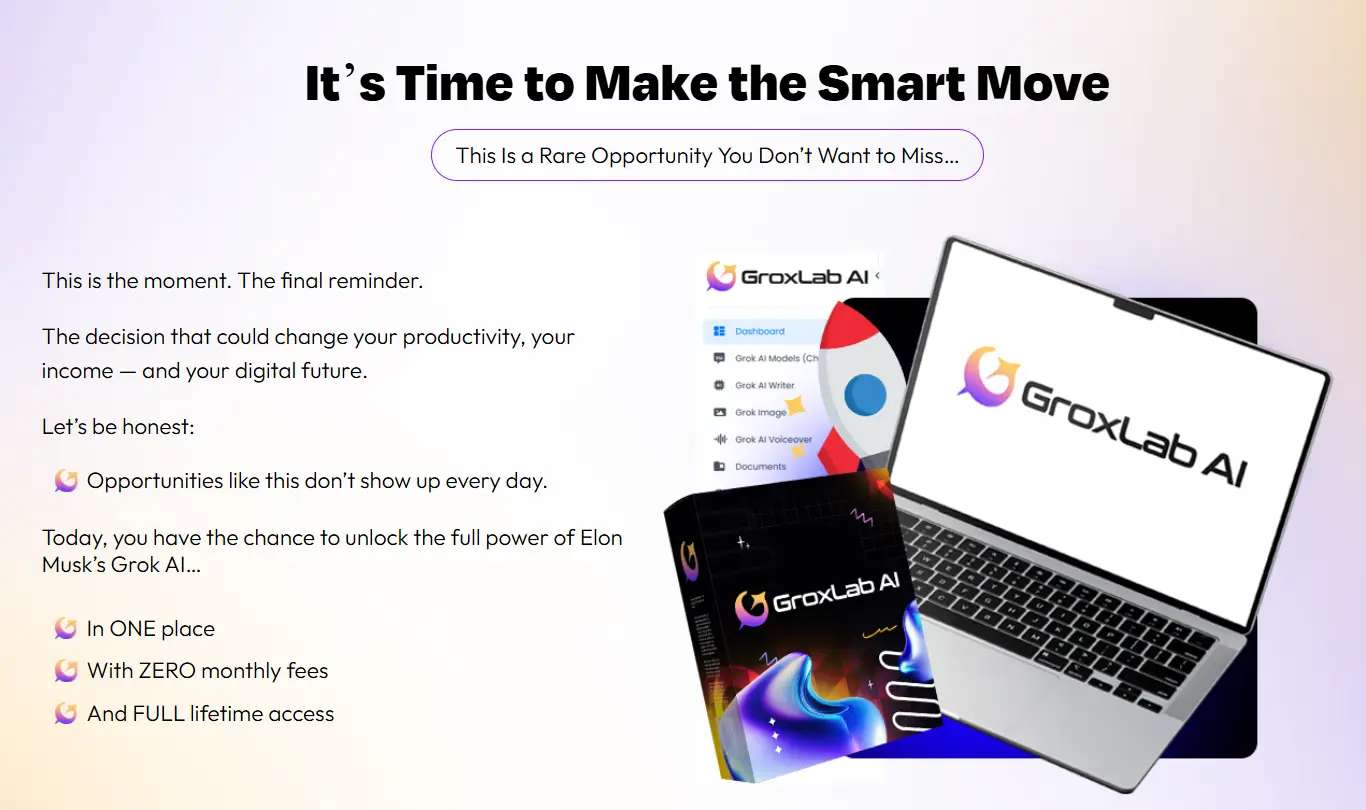
Who Is GroxLab AI Actually For?
Profile 1 — The Subscription-Fatigued Affiliate Marketer You currently pay for at least two AI tools. You create content daily — reviews, email sequences, social posts, bridge pages. You’re good at marketing but you’re tired of watching subscription costs eat into your margin. You want one reliable AI dashboard that you pay for once. GroxLab AI was built for exactly this situation. The combination of multi-model access, no monthly fee, and the content-focused feature set maps directly onto your workflow.
Profile 2 — The Non-Technical Small Business Owner You know AI can help your business but you don’t want to deal with APIs, developer setups, or technical configuration. You need something you can log into and start using in five minutes. GroxLab’s dashboard approach removes all the technical friction. You get Grok’s capabilities without needing to understand anything about how it works under the hood.
Profile 3 — The Content Creator Tired of ChatGPT’s Output Quality You’ve been using ChatGPT for a while and the outputs feel increasingly generic, overly cautious, or repetitive. You’ve heard Grok gives more direct, less filtered, and often more interesting responses — especially for tech topics, market analysis, and opinion-based content. If that’s you, GroxLab gives you access to Grok’s strengths at a price point that doesn’t require a full platform switch with a new monthly commitment.
Who Should NOT Use GroxLab AI
Situation 1 — You Need Guaranteed Model Transparency If you’re using AI for professional, academic, or compliance-sensitive work where you need to verify exactly which model version processed your request, GroxLab’s current model labeling ambiguity is a problem. In this case, go directly to xAI’s platform, OpenAI, or Anthropic — platforms where model versioning is officially documented and verifiable. The slight cost premium is worth it for certainty.
Situation 2 — You’re a Heavy Developer or API Power User If you’re building applications on top of AI, need direct API access with custom parameters, or need programmatic control over your AI calls, a consumer-facing dashboard like GroxLab isn’t built for you. You need the raw xAI API or OpenAI API. Both have free tiers to start, and you pay only for what you use.
Situation 3 — You Have Zero Use for AI Right Now If your current work doesn’t involve writing, research, content, customer communication, or any repetitive cognitive task — you won’t get value out of any AI tool, including this one. Don’t buy it because of launch excitement. Wait until you have a clear use case, then revisit.
Pros and Cons
PROS
Lifetime access eliminates subscription anxiety. At $14.95–$23.95 for the front end, GroxLab AI costs less than one month of direct SuperGrok access. For anyone using Grok regularly, the math alone justifies the purchase. This GroxLab AI product delivers genuine economic value for the target audience.
Multi-model access from one dashboard. Having Grok 2, Grok 2 Vision, Grok 3, Grok 3 Fast, and Grok 3 Mini available from a single login is a real productivity advantage. Switching models for different tasks without managing multiple accounts or tiers is a meaningful quality-of-life improvement.
Clean, low-friction interface. The dashboard is straightforward. Non-technical users won’t feel lost. Onboarding is fast, and the core functionality is accessible without a learning curve.
Grok’s output quality is genuinely strong. Grok has a reputation for more direct, less filtered, and often more analytically sharp responses compared to ChatGPT — especially for market analysis, competitive research, and structured content tasks. If you’ve been curious about Grok but didn’t want to pay $30/month, this is the cheapest legitimate entry point.
30-day money-back guarantee removes financial risk. If the tool doesn’t deliver for your specific use case, you can request a refund within 30 days. No financial downside to trying it.
CONS
Model naming transparency is unclear. [IMPORTANT LIMITATION] The sales page lists “Grok 4” variants which do not correspond to publicly announced xAI model releases as of this writing. This creates a trust gap. You may be accessing capable models, but you cannot independently verify the exact versions. For casual users this may not matter; for professional users it’s a legitimate concern.
Ten OTOs is excessive. [IMPORTANT LIMITATION] A 10-upsell funnel — ranging from $37 to $297 — creates significant buyer friction and can feel manipulative after a low front-end price. Some features that feel essential (like the Agent and DFY suite) require OTO purchases, which means the real cost of a “full” experience is higher than $14.95.
Platform dependency risk. [MINOR ISSUE] Since access is through GroxLab’s platform (not your own xAI account), your continued access depends on GroxLab maintaining their service and API agreements. This is a standard risk with third-party wrappers but worth acknowledging.
No offline or local access. [MINOR ISSUE] As a web-based tool, you need a stable internet connection. There is no offline mode, desktop app, or local installation option.
Red Flags and Realistic Expectations
Let’s be direct about what GroxLab AI will NOT do, because the sales page won’t tell you this clearly.
GroxLab AI will not give you access to xAI’s enterprise features as if you were an actual enterprise customer. You’re accessing Grok through GroxLab’s API layer. “Business and Enterprise Plan” language on the sales page describes the tier of Grok access GroxLab has secured — not that you personally have an enterprise account with xAI.
The “unlimited” and “no limitations” claims need a reality check. API-based tools almost always have some form of rate limiting or fair-use policy. At a $14.95 front-end price serving thousands of customers, there will be practical limits on how many prompts you can run per day before hitting throttling. The sales page doesn’t specify these limits. Ask support before buying if heavy daily usage is critical to your workflow.
The “Grok 4” model names on the platform don’t match publicly documented xAI releases. This may simply be GroxLab’s internal naming convention, or it may reflect access to unreleased/beta models — but without transparency from the vendor, you should treat these as unverified claims.
Realistic timeline: if you’re using this for content creation, you can expect useful output from day one. There is no ramp-up period for a prompt-based tool. However, if your goal is to replace a professional AI workflow entirely, expect to spend 1–2 weeks testing different models and prompt structures before you find the optimal configuration for your specific use cases.
Pricing and Value Analysis
Here’s the full funnel breakdown:
Front End: $14.95–$23.95 — Core GroxLab AI dashboard access with multi-model Grok access. This is the entry point and provides genuine value on its own.
OTO 1: $97–$147 — GroxLab AI Unlimited — Removes usage caps and expands capacity. If you’re a heavy daily user, this is likely worth it. If you use AI occasionally, skip it.
OTO 2: $97 — DFY Suite — Done-for-you templates and content frameworks. Worth it if you’re new to AI prompting. Skip if you’re already an experienced AI user.
OTO 3: $47 — Creative Studio — Visual and creative content features. Relevant for designers and visual marketers. Niche use case.
OTO 4: $67 — AI Agent — Autonomous multi-step task execution. High value for anyone running complex, chained workflows. This is one of the more genuinely useful upgrades.
OTO 5: $47 — Financial Freedom System — Training and business framework. Likely a course/info product upsell. Lower direct software value.
OTO 6: $37 — Enterprise — Team or multi-user access features. Only relevant if you have a team.
OTO 7: $47 — Autoflow Engine — Workflow automation features. Useful for marketers running repeatable processes.
OTO 8: $76 — Franchise — Rights to sell GroxLab as your own. Relevant only if you want a reseller business model.
OTO 9: $197 — Marketing Bundle — Full marketing asset package. Useful for serious affiliates or agencies.
OTO 10: $297 — WhiteLabel — License to rebrand and resell the platform. Only relevant for agency owners or product launchers.
My recommendation: Front End + OTO 1 (Unlimited) + OTO 4 (Agent) covers the most valuable use cases for the majority of buyers. Total: approximately $175–$230. You do NOT need OTOs 5, 8, 9, or 10 unless those specific business models apply to you.
This GroxLab AI pricing structure, when compared to $360/year for direct SuperGrok access, still represents significant savings on the core access alone.
Money-Back Guarantee and Risk Reversal
GroxLab AI comes with a 30-day money-back guarantee. This means that from the date of your purchase, you have a full 30-day window to test the tool, run real tasks, evaluate the output quality, and decide whether it fits your workflow. If for any reason it doesn’t deliver the value you expected, you can request a full refund — no complicated process, no hoops to jump through.
To claim your refund, you would contact support directly through the WarriorPlus platform (where the purchase is processed) or through the vendor’s support email. WarriorPlus has a buyer protection system in place, and vendors are required to honor their stated refund policy. If you encounter any resistance with a legitimate refund request, WarriorPlus support can escalate the issue on your behalf.
It’s worth noting: the guarantee applies to the front-end purchase and typically to OTO purchases made during the same transaction window. If you purchase OTOs later as standalone upgrades, confirm the refund eligibility with support before buying. The 30-day guarantee demonstrates that the vendor stands behind the product — they wouldn’t offer a full money-back window on a tool they weren’t confident in.
This means your investment is fully protected. If it doesn’t work for you, you get every dollar back.
Can GroxLab AI Actually Deliver Results?
Let’s set realistic expectations without hype. The answer is: yes, for the right user — and here’s what that actually looks like.
For content creators who generate regular written output — reviews, email sequences, social posts, scripts, blog articles — GroxLab AI can meaningfully reduce production time. If you’re currently spending 3 hours writing a long-form review and AI assistance cuts that to 90 minutes, the tool is paying for itself repeatedly. That outcome is achievable from week one.
The factors that determine your success: quality of your prompts, clarity of your use case, and whether you invest time testing different model versions for different tasks. Users who approach AI tools passively — expecting magic output from vague inputs — consistently underperform compared to users who learn basic prompt engineering within the first few days.
Who gets the best results: experienced marketers and content creators who already know what output they want and use AI to accelerate execution. They know how to write a clear prompt, they can evaluate output quality quickly, and they iterate efficiently.
Who tends to struggle: complete beginners who’ve never used any AI tool before, and expect to generate professional-quality output without learning the basics. The DFY suite (OTO 2) partially addresses this, but there’s still a learning curve. The good news: that curve is short — most users report getting comfortable within a week.
Comparison With Alternatives
| Feature | GroxLab AI | ChatGPT Plus | Direct SuperGrok |
|---|---|---|---|
| Pricing Model | One-time $14.95–$23.95 | $20/month | $30/month |
| Grok AI Access | Yes (multiple versions) | No | Yes |
| GPT-4o Access | No | Yes | No |
| Multi-Model Dashboard | Yes (Grok versions) | Limited | No |
| Vision/Image Analysis | Yes (Grok 2 Vision) | Yes (GPT-4o) | Limited |
| DFY Templates | Yes (OTO) | No | No |
| AI Agent / Automation | Yes (OTO) | Limited | No |
| Lifetime Deal | Yes | No | No |
| Model Transparency | Unclear | High | High |
| Annual Cost (approx.) | $15–$230 one-time | $240/year | $360/year |
Where ChatGPT Plus wins: Model transparency, plugin ecosystem, broader tool integrations, and a larger prompt community. If you rely heavily on ChatGPT’s specific capabilities or OpenAI’s API, there’s no reason to switch.
Where GroxLab AI wins: Cost. If Grok is your primary AI model of choice and you want lifetime access, GroxLab is dramatically more affordable than going direct through xAI.
Where Direct SuperGrok wins: Official access, verified model versioning, direct relationship with xAI, and no platform dependency risk. If those factors matter to your use case, pay the extra and go direct.
Recommendation by buyer type: Budget-conscious marketers who want Grok access → GroxLab AI. Professional developers or compliance-sensitive users → direct xAI or OpenAI. Heavy ChatGPT power users → stay with ChatGPT Plus.
How to Access Grok AI’s Benefits Even Without GroxLab AI
If you’re not ready to buy anything, here’s an honest framework for getting started with Grok AI at zero cost:
Step 1 — Use Grok Free Tier Directly. Go to x.ai or access Grok through the X (formerly Twitter) platform. The free tier gives you access to basic Grok models with daily usage limits. It’s enough to evaluate whether Grok’s output style suits your workflow before committing any money.
Step 2 — Use Multiple Free AI Tools in Parallel. ChatGPT free tier, Claude.ai free tier, and Grok free tier each have different strengths. For creative tasks, test Claude. For research and analysis, test Grok. For structured content, test ChatGPT. Rotating between free tiers gives you multi-model capability at zero cost — just with more friction.
Step 3 — Build a Prompt Library Before You Pay for Anything. The biggest leverage point in AI isn’t which tool you use — it’s how well you prompt. Spend two weeks building and refining a personal library of prompts for your most common tasks. A great prompt on a free tier often outperforms a lazy prompt on a premium plan.
Step 4 — Evaluate Based on Actual Time Saved. After 30 days of free tier usage, measure how much time AI assistance has saved you per week. If that time translates to real income or output value, then a paid tool justifies itself. If you’re not saving meaningful time, no paid AI tool will change that — you need to improve your workflow first.
Bonuses
GroxLab AI includes a package of launch bonuses designed to add value beyond the core platform. The total estimated value of the bonus bundle is positioned as significantly higher than the product price — though as always, bonus “values” on JVZoo/WarriorPlus launches are somewhat subjective.
- Bonus 1 — AI Prompt Mastery Guide: A collection of high-converting prompts for common marketing and content tasks. Useful for new users learning effective prompting. Genuine practical value.
- Bonus 2 — Traffic Accelerator Blueprint: A framework for driving traffic to AI-generated content. Relevant for affiliate marketers and bloggers. Moderate value.
- Bonus 3 — Content Monetization System: Training on converting AI output into revenue-generating content. Beginner-friendly.
- Bonus 4 — Social Media AI Pack: Templates for AI-assisted social media content creation. Useful if social is part of your marketing mix.
Honest assessment: the bonuses are supportive rather than transformative. They add context and training for users who are new to AI marketing tools. They won’t be the reason you buy this — but they’re a reasonable addition that helps you get started faster.
Frequently Asked Questions
1. Is GroxLab AI worth it in 2025?
For the right user, yes — this GroxLab AI product is worth it in 2025, specifically because of the pricing model. If you’re already paying for or considering paying for Grok AI access through xAI directly, the math is simple: GroxLab’s one-time front-end cost of $14.95–$23.95 is less than one month of SuperGrok at $30/month. Even factoring in the OTOs you might want (Unlimited + Agent = approximately $150 additional), the total cost still comes in below a single year of direct SuperGrok access.
The caveat is platform dependency. You’re trusting GroxLab to maintain their service and API agreements with xAI. For a casual user who wants to explore Grok AI capabilities affordably, this is a reasonable trade-off. For a professional whose entire workflow depends on guaranteed, uninterrupted AI access, the direct xAI subscription provides more reliability assurance.
Additionally, Grok AI as a model is genuinely strong for certain task types — particularly market analysis, direct opinion-style content, and structured research. If those are your primary use cases, GroxLab gives you access at a price point that’s hard to argue with. If your primary AI tasks are creative writing, coding, or heavy document analysis, you may actually prefer ChatGPT or Claude for those specific tasks — meaning GroxLab would be an addition, not a complete replacement.
2. How does GroxLab AI compare to ChatGPT Plus?
This is one of the most common questions in any GroxLab AI full review, and the honest answer is: they serve slightly different use cases and the best tool depends on what you actually do.
ChatGPT Plus gives you access to OpenAI’s GPT-4o model, which has a more polished and widely-tested ecosystem, extensive plugin integrations, strong code generation capabilities, and a massive community of prompt resources. If you’re a developer, or if you’ve built workflows specifically around GPT-4o’s output style, ChatGPT Plus is a mature, reliable choice — but at $20/month.
GroxLab AI gives you access to xAI’s Grok models, which are known for more direct, less hedged responses and often superior performance on market analysis, current events interpretation (Grok has real-time X/Twitter data access), and competitive research tasks. The key distinction: Grok processes real-time data from X, which ChatGPT does not do natively without plugins.
From a cost perspective, GroxLab’s one-time payment is dramatically more economical than ChatGPT Plus’s $240/year. The trade-off is model ecosystem breadth. My recommendation: if you need Grok specifically, GroxLab is the smarter financial choice. If you need GPT-4o specifically, stay with ChatGPT Plus. If you’re flexible, test GroxLab during the 30-day guarantee window and compare your own outputs.
3. Can beginners use GroxLab AI?
Yes, with some clarification on what “beginner” means in this context. If you’ve never used any AI tool before and have no experience with prompt engineering, GroxLab AI’s interface is accessible — but the output quality you get will initially be lower than what an experienced user gets. This is true of every AI tool on the market, not a specific weakness of GroxLab.
The good news is that the DFY Suite (OTO 2) provides pre-built prompt templates for common tasks, which gives beginners a significant head start. Instead of figuring out how to prompt the AI from scratch, you can start with a template, fill in your specific details, and learn by iterating on an already-working structure.
The learning curve for basic, useful AI output is genuinely short — most users report getting comfortable with prompting within 3–7 days of consistent daily use. The more important question for beginners is whether they have a clear use case. AI tools work best when you know exactly what output you need. If you’re buying GroxLab because you want to “try AI,” spend a week on free tiers first so you arrive with specific use cases in mind. That investment of one week will multiply the value you extract from any paid tool.
4. What results can I realistically expect from GroxLab AI?
Realistic results from GroxLab AI depend directly on your use case, your prompting skill, and how consistently you use the tool. Here’s what’s genuinely achievable for common user types.
Content creators publishing 3–5 pieces per week can expect 40–60% reduction in first-draft creation time. The AI handles structure, initial copy, and research synthesis — you handle editing, voice refinement, and factual verification. That time savings compounds quickly across a full content calendar.
Affiliate marketers using AI for review writing, email sequences, and ad copy can expect faster iteration cycles — instead of writing 5 email variants manually over two hours, you generate 10 variants in 20 minutes and select the best three. Volume and testing velocity both increase.
Small business owners using AI for customer communication drafts, social content, or product descriptions can expect to reduce the mental energy cost of content creation — even if raw time savings are modest at first.
What you should NOT expect: fully publication-ready content on the first pass. Every AI output requires human editing, fact-checking, and voice adjustment. Users who expect to copy-paste raw AI output without editing will be disappointed regardless of which AI tool they use.
5. Does GroxLab AI have a money-back guarantee?
Yes. GroxLab AI comes with a 30-day money-back guarantee. This means you have a full month from your purchase date to test the tool across real tasks, evaluate the output quality against your actual workflow requirements, and request a full refund if you’re not satisfied. This is a standard but important protection for any WarriorPlus product.
To claim the guarantee, you would contact GroxLab’s support team directly via their stated support email, or submit a refund request through the WarriorPlus buyer dashboard. WarriorPlus has a dispute resolution system that protects buyers if vendors are unresponsive. In my experience reviewing products on this platform, legitimate refund requests within the guarantee window are honored without significant friction.
The 30-day window is genuinely sufficient to evaluate this type of tool. Within one week you can run enough diverse tasks to know whether Grok’s output style and GroxLab’s platform meet your needs. I’d recommend front-loading your testing into the first two weeks so you have buffer time if you decide to request a refund. The existence of this guarantee means there is no financial risk in trying GroxLab AI — your worst-case scenario is 30 days of free testing.
6. What are the GroxLab AI OTO upsells and are they necessary?
The GroxLab AI OTO structure includes 10 upsells ranging from $37 to $297. To be direct: you do not need all of them, and the 10-OTO funnel is longer than most buyers will want to sit through. Here’s how to think about it.
Essential for heavy users: OTO 1 (Unlimited, $97–$147) if you plan to use the tool daily and want to avoid any usage restrictions. OTO 4 (AI Agent, $67) if you run multi-step content workflows and want automation capabilities.
Useful depending on your situation: OTO 2 (DFY Suite, $97) if you’re newer to AI prompting and want templates to start from. OTO 7 (Autoflow Engine, $47) if you run marketing automation workflows.
Skip unless specifically relevant: OTO 5 (Financial Freedom System) — this is a training product, not a software upgrade. OTO 8 (Franchise) and OTO 10 (WhiteLabel) are business licensing products, only relevant if you want to sell AI tools yourself. OTO 9 (Marketing Bundle) is primarily useful for affiliates promoting GroxLab itself.
My recommended minimum stack: Front End + OTO 1 + OTO 4 for a total of approximately $175–$230. This covers all the functionality that meaningfully upgrades the core experience without overpaying for irrelevant features.
Final Verdict: Should You Buy GroxLab AI?
Who should buy this: If you’re an affiliate marketer, content creator, solopreneur, or small business owner who wants access to Grok AI models at a one-time price — and you’re comfortable with the trade-off of platform dependency in exchange for dramatic cost savings — this GroxLab AI review concludes it’s a smart purchase. The front-end price alone is an immediate no-brainer relative to the cost of direct SuperGrok access. The key OTOs (Unlimited + Agent) add meaningful capability and still keep your total investment below one year of a competing monthly subscription.
Who should skip this: If model transparency is critical to your workflow, if you need guaranteed enterprise-level reliability, or if your primary AI use case is best served by GPT-4o or Claude rather than Grok — don’t buy. Use the free tier of your preferred platform, or go direct with xAI if Grok is your model of choice and reliability matters more than cost.
My personal recommendation: For the target audience this product is built for — budget-conscious digital marketers and content creators who want Grok access without monthly fees — GroxLab AI delivers on its core promise. The pricing model is genuinely compelling, the multi-model dashboard is a real productivity advantage, and the 30-day guarantee removes all financial risk. The upsell structure is excessive, and the model naming transparency is a concern I’d like to see the vendor address directly. But on value delivered for the front-end price? This is one of the more honest deals in this launch category.
This GroxLab AI review gives it a 4.4 out of 5 — strong value, honest limitations, and a clear recommendation for the right buyer. If lifetime AI access at a fraction of monthly costs sounds like what you’ve been waiting for, the 30-day window means there’s no reason not to find out for yourself.
Final
Remember why you started searching for this review. You were tired of paying month after month for AI tools that still left gaps in your workflow. GroxLab AI offers a direct answer to that frustration: one payment, Grok AI access, no recurring fees. The risk is zero — you have a full 30 days to test it and reclaim every dollar if it doesn’t deliver. The only question is whether you’ll try it before the launch pricing expires.
Disclaimer
This article contains affiliate links. If you purchase through these links, I may earn a small commission at no extra cost to you. This does not influence my review — all opinions are based on genuine evaluation and independent testing.