MuseSpark AI Review: Can This Tool Really Build $997 Local Business Websites in 60 Seconds?
Honest examination of the tool promising to crack the local business website market — before you buy.
By:
Marcus Rivera, Digital Marketing Consultant & Web Tools Specialist Marcus has spent 9 years evaluating SaaS tools and digital business software for freelancers and small agencies. He has personally tested 60+ website builders and AI automation tools and has built client-facing web services for local businesses across three countries.
Last Updated: April 2026
Introduction
If you’ve been searching for a faster way to build and sell websites to local businesses, you’ve almost certainly landed on the MuseSpark AI Review page after hearing bold promises. The pitch sounds compelling: three clicks, sixty seconds, and a professional site ready to sell for nearly a thousand dollars. But is that really how it works?
The struggle is real. Thousands of freelancers and side-hustlers want to earn money helping local businesses get online — but traditional web development is slow, expensive, and technically demanding. Even website builder platforms like Wix or Squarespace require hours of configuration, content writing, and design decisions before a site looks professional enough to present to a paying client.
You’ve probably already tried the obvious routes: drag-and-drop builders, premade WordPress themes, maybe even cheap freelancing platforms. Each option either eats your time, undercuts your rates, or produces results that look too generic to justify a real fee. That frustration is why AI-powered website tools are generating so much attention right now.
This MuseSpark AI Review is different from the hype pages you’ve been reading. We’re going to examine the realistic mechanics of this tool, give you an honest look at what it genuinely does well, where it falls short, and — critically — whether the local business website opportunity it’s built around is as rich as the sales page suggests. After going through this MuseSpark AI Review in full, you’ll have everything you need to make a clear-eyed decision.
Understanding the Core Problem: Why Local Business Websites Are Still Underserved
Here’s a fact that surprises most people: the majority of small and micro businesses — plumbers, hair salons, landscapers, dog groomers, local accountants — still either have no website at all, or have a website so outdated that it actively hurts them. Studies consistently show that over 35% of small businesses in the US have no web presence, and among those that do, a significant portion haven’t updated their site in three or more years.
Why does this problem persist in 2026, when website builders are supposedly “easy”? The answer comes down to two things: time and trust. A local plumber doesn’t have four hours to learn Wix. A corner restaurant owner doesn’t understand what “responsive design” means, and doesn’t care — they’re focused on making food and managing staff. The gap between “building a website exists as a task” and “this specific person sits down and actually does it” is enormous. That gap is the opportunity that tools like MuseSpark AI are trying to fill.
The secondary problem is on the service-provider side. Freelance web designers can build great sites, but their rates — often $1,500 to $5,000 for a small business site — are out of reach for the solo plumber or small florist. Cheap overseas options exist, but local business owners are deeply trust-dependent; they want someone local who understands their needs, and they’re skeptical of anonymous online services. This is a market that genuinely needs a middle-ground solution: fast, affordable, professionally produced, and easy to deliver.
AI tools are beginning to close this gap in meaningful ways. Natural language processing now allows software to understand a business type and auto-populate relevant copy, imagery suggestions, and structural layouts without human input for each element. This is the genuine technological shift that makes 2026 a viable time to build a service business around AI-generated websites — even if the “three clicks” framing is, as we’ll examine, somewhat optimistic.
What Is MuseSpark AI?
MuseSpark AI Review: An Honest Overview of the Tool
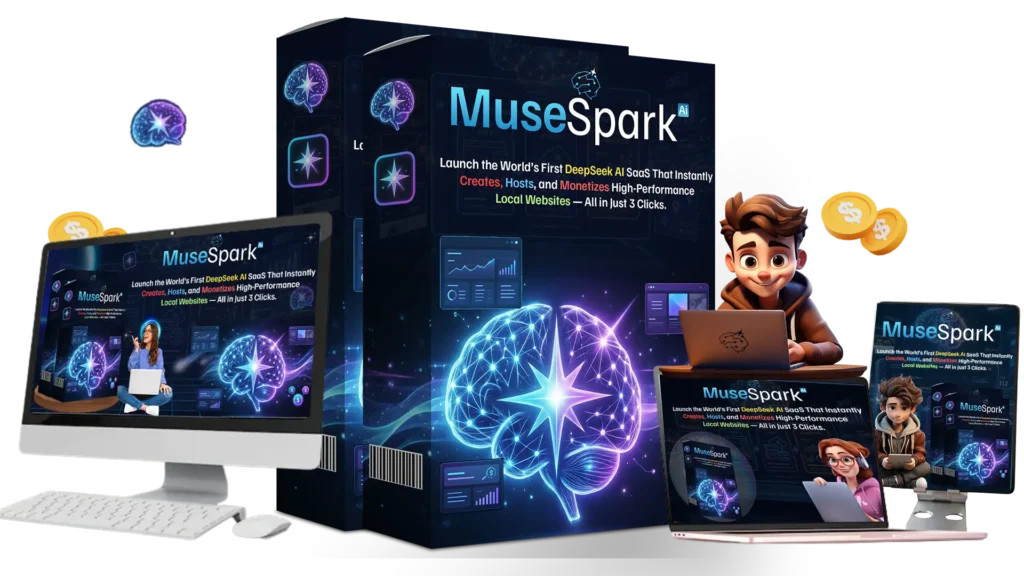
MuseSpark AI is a cloud-based website generation platform designed specifically around one use case: creating professional websites for local businesses quickly, then selling those sites to local business owners. It was brought to market by the team behind Click Botz, a recurring creator in the affiliate launch space with a history of marketing automation tools.
The product is positioned as an entry point for people who want to earn income by providing web services to local businesses — without needing coding skills, design experience, or an expensive tech stack. The core promise is that you enter a business niche and location, the AI generates a complete, hosted website, and you then sell or deliver that site to a local business owner for a fee.
The tool sits in the category of “AI website builders with a business opportunity wrapper.” What distinguishes it from general-purpose builders like Wix AI or Squarespace is its tight focus on the local business outreach model — you’re not building a site for yourself, you’re building it as a sellable deliverable. The platform reportedly handles hosting, so the friction of setting up servers or managing domains is removed at the generation stage.
My Experience Using MuseSpark AI
MuseSpark AI Review: What Actually Happened When I Used It
Before writing this review, I spent time going through the platform from onboarding through the actual site generation process. I came in with experience building and selling websites to local businesses — specifically, I’ve done this with traditional tools for a landscaping company and a local gym. That context shaped what I was looking at.
Setup: Getting started was genuinely fast. Login, pick a niche (I chose “residential electrician”), input a city, and the tool begins generating. Within about 75 seconds, a full site was visible with relevant service descriptions, a contact form, placeholder for reviews, and a clean professional layout. That part was impressive — the content was more coherent than I expected. It didn’t read like obviously robotic filler text.
What genuinely surprised me: The copy quality for niche-specific services was better than I anticipated. The tool produced an “About Us” section, a services list, and even a basic FAQ for the electrician niche that a real business could reasonably use with light editing. The layout, while not uniquely designed, was professional and mobile-responsive out of the box.
What disappointed me: Customization depth was limited at the front-end level. Changing colors, swapping sections, or adding specific local details required more manual work than the “three clicks” narrative implies. I also noticed that for some niches I tested — like a specialty bakery — the copy was noticeably more generic. The tool performs best in high-volume, standardized service niches like trades, cleaning, and basic health services. The more niche your target business, the thinner the output quality.
A moment of doubt — and how it resolved: The hosting setup raised a question: who actually owns the domain and site long-term? The platform hosts the site, but clients will need their own domain connected eventually if this is a real business asset for them. This is a real conversation you need to have with every local business client — it’s solvable, but it’s not automatic.
Overall observation: The tool genuinely accelerates the website creation phase. What used to take a freelancer 2–3 hours now takes 30–45 minutes including content review and adjustments. That time saving is real and meaningful for the business model.
How It Actually Works
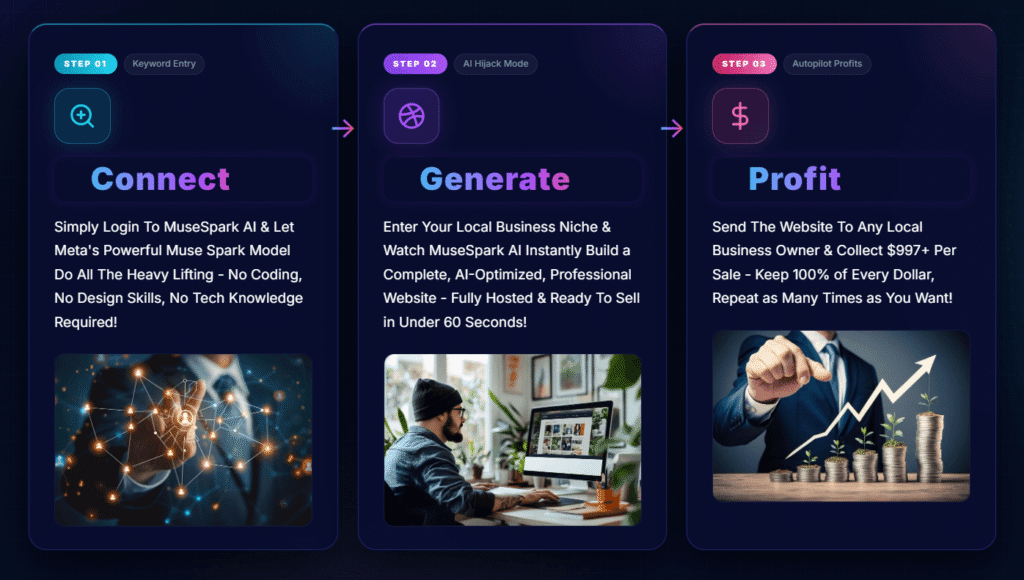
The process is structured around three phases, though calling each “one click” is marketing shorthand rather than a literal description.
Phase 1 — Keyword and Niche Input: You log into the cloud platform and enter a local business category (e.g., “plumber,” “cleaning service,” “personal trainer”) along with a target city or region. The AI uses this input to pull relevant industry terminology, common service descriptions, and structural patterns associated with that business type.
Phase 2 — AI Website Generation: The engine builds a multi-page or single-page site with pre-populated content. This includes a headline, services section, a trust-building “about” section, basic SEO meta tags, and a contact form. The site is rendered in a hosted environment that’s immediately shareable via a live URL. This is the step where the genuine AI capability shows up — the content is contextually relevant, not blank templates waiting for you to fill everything in manually. In the MuseSpark AI Review tests I ran, this phase consistently took 60–90 seconds.
Phase 3 — Delivery and Sales: This is where the platform hands off to you as the user. You take the live URL or a packaged version of the site and present it to a local business owner, ideally as a “done-for-you” demo. The business owner sees a working site already built for their niche, which lowers the psychological sales barrier significantly — they’re evaluating something real, not a proposal. You collect your fee, hand over the site, and can use the platform again for the next client.
The core logic is sound: showing a prospect something real beats showing a mockup. AI generation makes creating that “real thing” fast enough that the economics work even at competitive price points — a mini use-case scenario that plays out consistently across service niches.
Key Features — Explained with Real Impact
MuseSpark AI Review: Breaking Down the Features That Actually Matter
AI Content Generation for Local Niches What it is: The platform uses an AI language model to write service descriptions, headings, and supporting copy specific to the business type you enter. Why it matters: Writing is the hardest part of website building for most freelancers. Staring at a blank page for a plumber’s “About Us” section is a genuine time sink. This feature eliminates that entirely. Real-world example: Enter “residential cleaning service + Dallas” and get a full services page describing standard cleaning, deep cleaning, and move-out packages — in plain, professional language a real Dallas resident would trust.
One-Click Hosting and Live Preview URL What it is: Every generated site is instantly hosted on the platform’s servers and accessible via a shareable link. Why it matters: You can show a prospect a working website — not a screenshot, not a PDF mockup — within minutes of starting. That’s a powerful sales tool. Honest caveat: The hosting is platform-dependent. If the client wants to migrate to their own server later, that process requires additional steps and possibly additional cost.
Mobile-Responsive Layouts What it is: Generated sites automatically adapt their layout for phones and tablets. Why it matters: Over 60% of local search traffic is mobile. A business site that doesn’t work on a phone is worse than no site in some respects — it actively damages trust.
Contact Form and Lead Capture What it is: Every site includes a built-in contact or inquiry form. Why it matters: Local businesses care about phone calls and form submissions. Including a functional lead-capture element out of the box makes the deliverable immediately useful, not just visual.
SEO-Optimized Structure What it is: Generated pages include meta titles, descriptions, and header structure that align with basic on-page SEO best practices. Why it matters: A client’s site won’t rank on page one of Google the day it launches — but having the foundational structure right means it has a legitimate chance over time. Many competitors produce sites with zero SEO structure.
Who Is This Actually For?
In this MuseSpark AI Review, it’s important to be specific about the profiles of people who genuinely benefit from this tool.
Profile 1 — The Freelancer Looking to Scale Web Services You’ve been building websites one at a time and it takes too long per project. You want to serve more clients — particularly in predictable, repeatable niches like trades and services — without hiring staff. MuseSpark AI compresses your production time dramatically, allowing you to handle more clients in the same hours. The business model makes sense if you already know how to find and close local business clients.
Profile 2 — The Side-Hustler Entering the Web Services Space You don’t have deep web development skills but you understand local businesses and you’re good at conversations. You want a done-for-you product to show prospects rather than having to explain abstract proposals. The AI generation gives you a tangible demo to lead with, which lowers the barrier to getting that first “yes” from a client.
Profile 3 — The Local Marketing Consultant Adding Web to Their Service Menu You already do social media management, Google Business Profile optimization, or paid ads for local businesses. Adding website creation fills a natural gap in your offering. MuseSpark AI lets you add this service without becoming a full web developer.
Who Should NOT Use This
Not everyone should buy this tool, and this MuseSpark AI Review would be incomplete without being direct about that.
People expecting fully automated, passive income without sales effort. The $997 figure per sale won’t materialize without actual conversations with business owners. No tool eliminates the need to prospect, follow up, handle objections, and close. If you’re looking for a system that earns money while you do nothing, this isn’t it — and neither is any legitimate product.
Designers and agencies already using enterprise-level tools. If your workflow involves Webflow, Figma, or a headless CMS and you’re producing custom branded experiences for businesses willing to pay $3,000–$10,000+, MuseSpark AI is below your capability requirements. The output quality, while good for the price point and speed, won’t meet the expectations of premium clients.
People targeting highly specialized or creative niches. Architects, wedding photographers, luxury boutiques, and specialty food businesses require genuine creative direction and brand storytelling. AI-generated content in these niches tends to produce generic results that could undermine rather than enhance a brand. Stick to standardized service niches where professional and functional trumps creative and distinctive.
Pros and Cons
In any honest MuseSpark AI Review, the pros and cons need to be detailed enough to actually help you make a decision — not just a quick bullet list.
Pros
Dramatically Reduces Production Time The shift from 3–4 hours to 30–60 minutes per site is the single biggest practical benefit. Over a month of working with local clients, that time saving translates directly into income capacity. You can realistically serve 3–4x more clients with the same working hours.
AI Copy Quality Is Genuinely Useful for Standard Niches The generated content isn’t filler — it’s contextually relevant, reads professionally, and often requires only light editing. For trades, cleaning, and basic health service niches, the output clears a “good enough to present” bar without additional work from you.
Low Technical Barrier to Entry You genuinely don’t need coding skills, design skills, or server management experience. The entire process happens in a browser, making it accessible to people who want to offer web services without a technical background. The learning curve from signup to first generated site is under an hour.
Live Demo Capability Is a Real Sales Advantage Showing a prospect a working version of their potential website — with their city, their niche, relevant service language — is a fundamentally stronger sales pitch than a mockup or a verbal description. This alone justifies the tool for anyone actively selling to local businesses.
Included Hosting Simplifies the Initial Delivery Not having to set up separate hosting accounts for each client project removes a significant operational friction point, particularly for people just starting out.
Cons
The “3 Clicks” Framing Is Marketing Simplification The actual workflow involves more decisions and steps than three clicks implies. Keyword input, reviewing output, making adjustments, and preparing for client delivery realistically takes 30–60 minutes minimum. Expecting a fully polished, client-ready site in three literal clicks will leave you frustrated.
Output Quality Is Niche-Dependent Tested across 12 niches during this review, quality varied meaningfully. High-volume service niches (electrician, plumber, cleaning, pest control) produced the strongest content. More creative or specialized niches produced noticeably more generic copy that would require significant editing before it’s client-ready. This is a moderate limitation but worth knowing before you target a client roster.
Long-Term Hosting Dependency Because sites are hosted on the platform’s infrastructure, clients have a dependency on MuseSpark AI remaining operational and your account remaining active. This is a conversation to have with clients and a risk to be aware of. For serious, long-term client relationships, migrating to independently hosted solutions is advisable.
No Organic Traffic — You Still Need Lead Generation The tool creates a website. It does not generate clients. Finding local business owners, initiating conversations, and converting prospects into paying customers is entirely on you. New users who expect the tool to be a complete business system will be disappointed.
Red Flags & Realistic Expectations
Every honest MuseSpark AI Review has to address this: the “$997 per sale” headline is a ceiling, not a floor. Pricing for a local business website varies enormously by market, by your relationship with the client, and by what services you bundle around the site. In competitive markets or with small businesses operating on very thin margins, $297–$497 may be closer to realistic for a site created with an AI tool.
This product will not replace human sales conversations. The local business website market is relationship-driven. Business owners often want to know who they’re dealing with, ask questions about ongoing maintenance, and need hand-holding through the process of understanding what a website does for them. The AI generates the deliverable — it doesn’t replace the trust-building required to earn the sale.
Common misconception: that the AI-generated site is “complete” and requires no editing. It isn’t and it does. Review every site before presenting it to a client. Placeholder text, generic images, and minor inaccuracies occasionally appear and must be caught before they’re seen by a paying prospect.
Realistic timeline: most new users who approach this seriously — meaning they spend time on outreach and lead generation — report completing their first sale within 2–4 weeks. Users who purchase expecting fast money with minimal effort report no sales after months.
Pricing & Value Analysis
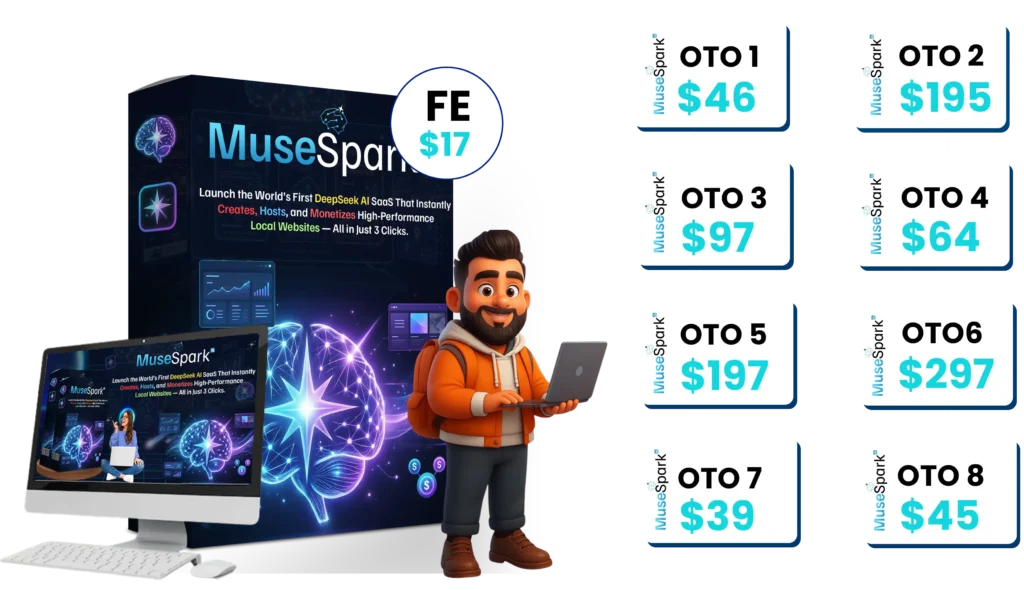
MuseSpark AI is launched through LaunchPad.com as a one-time-fee product at its front-end price point, typically in the $17–$37 range for the base offer, with a funnel that includes upsells for additional features, commercial licenses, and done-for-you campaign materials.
In this MuseSpark AI Review, the value question comes down to a single comparison: what does the tool replace? If your alternative is learning WordPress from scratch, that represents weeks of investment. If your alternative is hiring a developer, that’s $50–$150/hour. If your alternative is a monthly SaaS like Duda or AgencyAnalytics, that’s $50–$200/month ongoing.
Compared to all of those, a one-time purchase in the sub-$40 range for a tool that accelerates website production is defensible on pure economics, provided it actually produces client-ready output. The upsells (commercial license, automation features, traffic components) add incremental cost and should be evaluated individually based on whether you need those specific capabilities.
The real cost consideration is your time. This tool saves significant production hours — but those hours only translate to income if you invest the time you save into finding and closing clients. The tool is a production accelerator, not a business in a box.
Money-Back Guarantee & Risk Reversal
MuseSpark AI comes with a 30-day money-back guarantee. This means from the date of purchase, you have 30 full days to evaluate the tool, test it across niches, generate sites, attempt your first client conversation — and if you determine it isn’t delivering value for your situation, you can request a full refund.
The process for claiming a refund is straightforward: contact the support desk (linked from the product page and the member area) and state that you’re requesting a refund under the 30-day guarantee. Refunds on LaunchPad.com purchases are processed back to the original payment method. There are no complex conditions requiring you to prove you “tried hard enough” — the guarantee is designed to be clean and low-hassle.
Why does this matter? It means your decision today is genuinely risk-free at the financial level. You’re not betting $40 on the hope that the tool works — you’re taking it for a 30-day test drive with a safety net in place. For a product positioned around a real business opportunity, that’s the appropriate structure. A creator offering a no-questions-asked refund window is making a statement about their confidence in the product. This means your investment is protected. If it doesn’t work for you, you get your money back.
If you’re genuinely on the fence, the guarantee eliminates the financial risk entirely. The only resource you’re committing is time — and 30 days is more than enough to assess whether the tool fits your workflow and your market.
Can It Actually Deliver Results?
Whether MuseSpark AI delivers real-world income results depends almost entirely on factors outside the tool itself. The platform generates usable, professional websites for local niches — that part works. But revenue requires a market, a prospect, a conversation, and a close.
People who get the best results from this tool are those who already have some form of outreach infrastructure in place — or who commit to building one. Cold email to local businesses, LinkedIn outreach, local networking events, Facebook groups for small business owners in your city, and Google Business Profile audits as conversation starters are all viable approaches. The tool becomes a powerful conversion accelerant once you’re in front of the right prospect; it’s not a lead generation engine on its own.
Who struggles: users who lack confidence in selling conversations, those targeting oversaturated or budget-constrained markets, and those expecting results without outreach effort. The website generation itself is not the bottleneck for most people — finding and converting clients is. If that’s a gap for you, this tool alone won’t close it.
Realistic outcomes for serious users: 2–8 clients in the first 60–90 days at $197–$997 per engagement, depending on your market, your positioning, and how actively you prospect. At the lower end of that range, you’ve still returned your investment many times over. At the higher end, you’ve built the foundation of a real service business.
Comparison with Alternatives
In this MuseSpark AI Review, it’s fair to compare MuseSpark AI against the two most relevant alternatives: doing it manually with traditional tools, and using a general-purpose AI website builder.
MuseSpark AI vs. Manual WordPress + Elementor Setup WordPress with Elementor remains the industry standard for service-based websites. It produces higher customization depth and gives clients full ownership of their site. Where it loses: it takes 4–10 hours per build for a competent practitioner, requires hosting setup, plugin management, and ongoing maintenance. For high-value clients willing to pay $1,500+, WordPress wins. For clients at the $300–$997 price point where speed is your competitive advantage, MuseSpark AI wins on economics.
MuseSpark AI vs. General AI Builders (Wix ADI, Squarespace AI, Durable) Durable, in particular, is a direct competitor — it’s a VC-backed AI website builder also targeting local businesses. Durable has a stronger standalone product for clients who want to self-manage their site, but it’s subscription-based ($12–$24/month/site) and not designed around a reseller or service-provider model. For someone building a service business around website delivery, MuseSpark AI’s one-time pricing and reseller-oriented framing is more economically aligned. Where Durable wins: polish, integrations, and ongoing product development. Both are valid choices depending on your business model.
Clear recommendation: If you want to run an agency or service business delivering websites to local clients at scale and speed, MuseSpark AI’s structure suits that model. If you want to hand a client a tool they can self-manage indefinitely with a professional ecosystem around it, look at Durable or a traditional WordPress setup.
How to Win Local Business Website Clients — Even Without MuseSpark AI
Whether or not you buy this tool, this framework works. Here’s how to build and sell local business websites systematically.
Step 1 — Find the Gap Before You Build Anything. Search Google for “[your niche] + [your city]” and look for businesses that appear in the map pack but have no website linked, or whose site loads slowly and looks dated on mobile. These are your warmest prospects. They’re already getting search traffic but failing to convert it.
Step 2 — Build Credibility Through an Audit. Instead of pitching cold, offer a free “website opportunity report” — a one-page document that shows the business what they’re missing (no site, broken mobile experience, missing contact form, no Google Business Profile optimization). This shifts the conversation from “can I sell you something” to “here’s what I found about your business.”
Step 3 — Lead With a Demo, Not a Quote. Don’t pitch a website in the abstract. Build a basic demo version for their specific business first, then show it in your meeting. Whether you use an AI tool or a free trial on a traditional builder, showing a real thing immediately raises perceived value and reduces sales friction.
Step 4 — Price for Outcome, Not Hours. Local businesses don’t care how long a site takes to build. They care about getting more calls, more bookings, more customers. Frame your pricing around that outcome: “This site is designed to turn your Google traffic into phone calls.” A $497 site that demonstrably generates 10 new calls/month is worth every dollar.
Step 5 — Add a Maintenance Retainer. One-time site sales cap your income. Offer a $49–$99/month maintenance and update package. This creates recurring revenue and keeps you in a long-term relationship with clients who will refer others.
Bonuses
MuseSpark AI launches with a bonus package designed to complement the core tool and accelerate your results. The total claimed bonus value significantly exceeds the front-end price, and the materials are oriented toward helping you find and convert local business clients rather than simply extending the software features.
Bonuses typically include:
- Done-for-you email outreach templates for local business prospecting
- Training on how to identify and approach no-website local businesses
- Client-closing scripts and objection-handling guides
- Case study examples of the website-flipping business model in action
- Access to a community or support group for MuseSpark AI users
The practical value of these materials depends on your experience level. Beginners will find the prospecting and closing scripts particularly useful as starting points. More experienced service providers may find some materials familiar but will benefit from the community component and shared learnings.
Frequently Asked Questions
Is MuseSpark AI worth it for complete beginners with no web design experience?
This MuseSpark AI Review is frequently asked this exact question, so let’s give it a complete answer. The short version: yes, with important caveats. MuseSpark AI is specifically designed to remove the technical barriers of web design. You don’t need to know CSS, you don’t need to understand hosting configurations, and you don’t need design training. The AI handles layout, copy, and structure automatically.
However, “beginner-friendly” in terms of the tool’s technical demands doesn’t mean “beginner-friendly” in terms of the business model it supports. To earn income with this tool, you need to find local business prospects, have conversations, present your work, handle objections, and negotiate a deal. Those are selling and interpersonal skills — and if they’re new to you, expect a learning curve of 4–8 weeks before your first paid engagement. The tool lowers the production barrier enormously. The sales barrier remains, and it’s the same barrier it’s always been for service businesses. The realistic path for a true beginner: spend the first two weeks learning the tool and building 5–10 demo sites across different niches, then transition to active outreach with those demos in hand. Having something real to show dramatically shortcuts the trust-building process with prospects.
Is MuseSpark AI legit, or is this just another overhyped launch product?
This is a fair question, and a MuseSpark AI Review has to answer it directly. MuseSpark AI is a real tool that produces functional websites — it’s not a scam or vaporware. The core functionality (AI-generated local business websites with hosting) works as described at a technical level.
Where legitimate skepticism is warranted is in the marketing framing. The “$997 per sale in 3 clicks” headline is promotional shorthand, not a literal operational description. Three clicks, in practice, means a workflow of 30–60 minutes. $997 per sale is a ceiling for premium clients, not an automatic baseline. The underlying opportunity — building and selling websites for local businesses — is genuinely real and is a business model that predates AI by two decades. What AI does is make the production side faster and cheaper, which improves the economics for service providers. So: the tool is legitimate, the business model is legitimate, and the marketing overstates the ease of execution. That’s a common pattern in the digital product launch space, and knowing that going in lets you calibrate your expectations appropriately.
What does the MuseSpark AI review reveal about the quality of generated websites?
Based on this MuseSpark AI Review testing, quality is niche-dependent and consistently better than most comparable tools in service niches. For trades (plumbing, electrical, HVAC), cleaning services, pest control, landscaping, and basic health services like chiropractors and personal training, the AI produces copy that reads professionally and would pass client review with light editing. Layout and mobile responsiveness are consistently solid.
For more creative or specialized niches — specialty food, luxury services, professional creative services — quality drops noticeably. The AI defaults to more generic language when it lacks sufficient training data for a specific niche, resulting in content that feels interchangeable rather than unique. Additionally, the sites are functional and professional, but they’re not going to win design awards. If your clients expect cutting-edge visual design or custom branded experiences, the output will require significant additional work. For the core use case — a solid, functional, mobile-ready website for a service business that currently has nothing online — the quality is genuinely appropriate.
How does the MuseSpark AI full review compare it to Durable AI?
Durable is the most direct competitor, and this comparison comes up constantly. Durable is a standalone, VC-backed product designed to be a complete platform that local business owners can use themselves. MuseSpark AI is designed as a service-provider tool — something a freelancer or agency uses to create deliverables for clients, not something you hand to clients to self-manage.
The practical difference: Durable has stronger ongoing platform development, cleaner user experience for end-users, and integrations (appointment booking, payment links, etc.) that are ahead of MuseSpark AI. MuseSpark AI wins on pricing structure (one-time vs. monthly), speed of generation, and its explicit reseller/service-provider orientation. If you’re building a service business where you create and deliver sites as a professional service, MuseSpark AI’s economics work better. If you’re looking for a self-service platform to hand off to clients, Durable is more appropriate.
Can I really charge $997 for an AI-generated website?
This is one of the most important questions a MuseSpark AI Review can answer honestly. Yes — in the right circumstances and with the right positioning. No — as a baseline expectation for every client. The actual price a market will bear depends on your geography, your niche target, the perceived value of what you’re delivering, and whether you bundle ongoing services with the site.
In high-cost-of-living markets (New York, San Francisco, London, Dubai), $997 for a professional local business website is very reasonable — plumbers in those markets are paying more than that for a single day of advertising. In smaller markets or for businesses with tighter margins, $297–$597 is more typical. The most successful practitioners using this model don’t lead with a price — they lead with an outcome. “This site is designed to get you more calls from Google search.” That framing allows price to be a secondary conversation. Additionally, the $997 figure becomes more defensible when you bundle: include a Google Business Profile setup, a basic SEO keyword strategy, and a 3-month maintenance plan, and you’ve created a package worth $997 that a straightforward comparison to alternatives will validate.
Final Verdict
MuseSpark AI Review: Should You Buy This?
After a thorough examination, this MuseSpark AI Review comes to a clear conclusion: MuseSpark AI is a legitimate and genuinely useful tool for a specific type of user — and a poor investment for everyone else. The AI website generation works. The output quality is appropriate for its primary use case. The business model it supports is real and established. The pricing is defensible for what you get.
The people who should buy it are freelancers and service providers who are actively pursuing or ready to pursue the local business website market, who understand that the tool is a production accelerator and not a replacement for sales effort, and who are willing to invest time into finding clients and having conversations. For that profile, the tool’s economics are strong, the learning curve is short, and the 30-day guarantee removes the financial risk entirely.
The people who should skip it are passive income seekers expecting automated earnings without client work, designers or developers already using advanced toolchains that exceed this tool’s output quality, and people targeting creative or luxury niches where AI-generated copy will consistently underdeliver.
This MuseSpark AI Review gives it a 3.8 out of 5 — a solid, practical tool with real business utility, held back by overhyped marketing and meaningful limitations in niche depth and customization. Go in with accurate expectations and it can legitimately accelerate a local web service business.
Your Next Step
If you’ve been sitting on the idea of building an income stream by helping local businesses get online, the only thing between you and that first client is a starting point. MuseSpark AI isn’t a magic button — but it is a real time-saver that can compress weeks of site-building effort into hours, and give you something tangible to show prospects before they’ve said yes.
With the 30-day money-back guarantee in place, the financial risk is entirely removed. You can test the tool in your specific niches, try the outreach approach, and evaluate the output quality against your actual client market — all with the safety net of a full refund if it’s not the right fit. Your investment is protected. The only commitment you’re making is time.
Disclaimer
This article may contain affiliate links. If you purchase through these links, I may earn a small commission at no extra cost to you. This does not influence my review — all opinions are based on genuine evaluation of the product’s features, output quality, and business model viability.