Super 7 Review: Is This 7-in-1 AI Platform Worth It — Or Just Another Overhyped Tool?
Can one dashboard really replace $720/month in separate AI subscriptions? Here's the unfiltered truth before you buy.
Introduction
If you’ve been searching for an honest Super 7 Review, you’ve probably already seen the flashy sales page making some very bold promises — seven premium AI models, a dedicated server, and a one-time fee that supposedly replaces $720 per month in subscriptions. It sounds almost too good to be true, and that’s exactly why I put this together. I’ve spent years evaluating AI tools in the digital marketing space, and I know how easy it is to get swept up in launch-day excitement only to feel buyer’s remorse a week later.
Here’s what most reviews won’t tell you: the AI tools market is flooded right now. Every week there’s a new platform claiming to be the “ChatGPT killer.” Most of them are rebranded wrappers with a shiny interface and an aggressive sales funnel. Some of them, however, genuinely solve a real problem that everyday marketers and creators face — paying for too many separate tools, juggling too many tabs, and still getting mediocre results because no single AI is great at everything.
So what is Super 7, really? Is it a genuine solution to the multi-AI chaos most of us live in — or is it another overpromising product that will underdeliver post-launch? In this review, I’ve gone through the JV materials, demo videos, sales page documentation, and funnel structure in detail. I’m going to walk you through everything clearly — the good, the concerning, and the realistic expectations — so you can make a smart decision for yourself.
This Super 7 Review is different from what you’ll find elsewhere because I’m not here just to sell you something. I’m here to make sure you understand exactly what you’re getting into before you click buy. By the time you finish reading, you’ll know whether this is right for you — or not.
Super 7 is just one piece of the puzzle. If you want to dominate the USA affiliate market this year, you need the right ecosystem. Check out our Ultimate Guide to AI Marketing Tools 2026 where we rank the top-performing software that every digital entrepreneur needs.
Understanding the Core Problem — The Multi-AI Trap
Let’s start with the real problem, because this is what Super 7 was supposedly built to solve.
If you’ve been in online marketing or content creation for any length of time, you’ve watched AI go from a novelty to a necessity almost overnight. ChatGPT changed everything in 2023. Then came Claude for better writing and coding. Then Gemini for images and multimodal tasks. Then Grok for real-time research. DeepSeek for reasoning-heavy work. Perplexity for source-cited answers. Microsoft Copilot for productivity and documents.
Here’s the uncomfortable reality: no single AI is the best at everything. ChatGPT is generalist and reliable, but it’s no longer the best coder, the best image generator, or the best researcher. Claude outperforms it for nuanced writing and software development. Gemini edges ahead for image-related tasks. Grok has live data access from X (Twitter) that no other model can match. If you want genuinely excellent results, you need to know which AI to use for which task — and then you need active subscriptions to all of them.
That’s where the problem explodes financially. Claude Pro runs $20/month. Gemini Ultra is $20–$250/month depending on tier. Grok Premium is $16/month. Perplexity Pro is $20/month. Add a dedicated VPS for running automation, Copilot Enterprise features, and you’re looking at real money draining out every single month — often for tools you use only partially. Most marketers end up with 3–4 subscriptions they’re underusing, or they settle for the free, limited versions and get mediocre output.
The second layer of this problem is cognitive overhead. Even if you can afford all the tools, you’re constantly switching between dashboards, copying outputs from one AI into another, losing context, and wasting time figuring out which tool handles what best. This mental tax is real, and it’s why a unified AI command center — if it works as advertised — is genuinely valuable.
This is the exact gap Super 7 positions itself to fill. The question is whether it actually does.
What Is Super 7? — A Closer Look at This Super 7 Review
Super 7 is a cloud-based software platform that launches on April 20, 2026, created by the team behind LaunchPad — a well-known WarriorPlus affiliate software vendor. The product is built around a concept called the OpenClaw engine, which is described as an AI orchestration layer that sits on top of seven different premium AI models and automatically selects the best one for any given task you throw at it.
In plain English: instead of you deciding whether to use Claude or Gemini or DeepSeek for a task, you simply type your request and OpenClaw picks the right model and runs it — all inside one dashboard. The platform runs on a dedicated cloud server (not your local computer), meaning it operates 24/7 without you keeping a machine running.
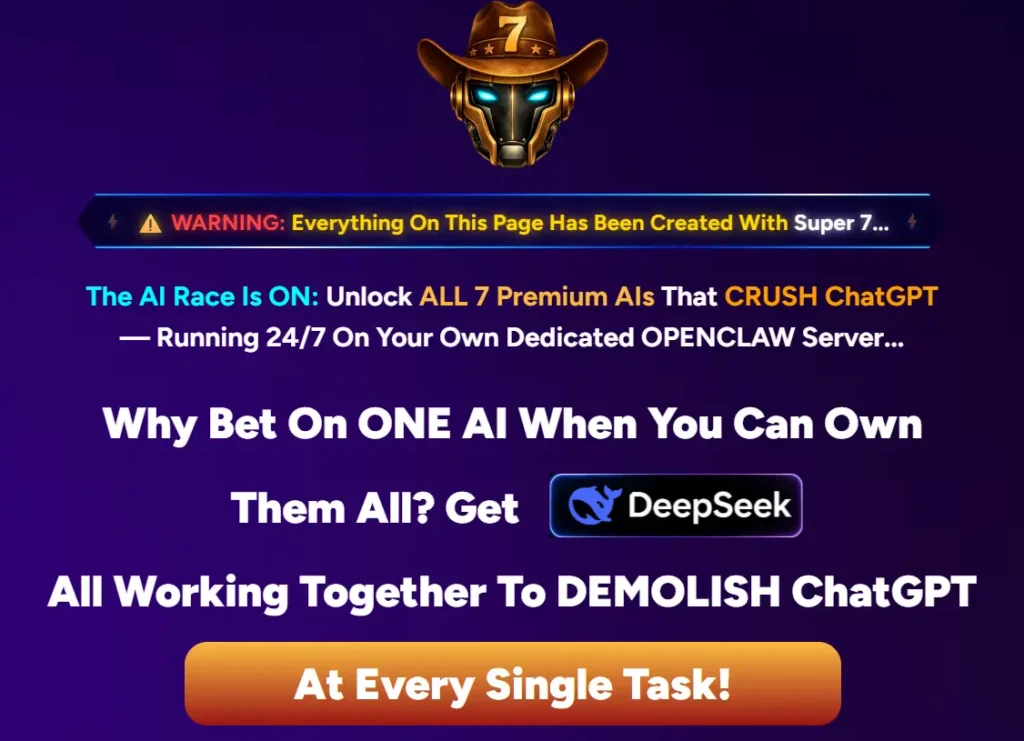
The seven AI models included are: Claude (for coding and development), Gemini Ultra (for image generation and editing), Grok (for real-time research via live X data), DeepSeek (for complex reasoning), Microsoft Copilot (for document automation), Manus AI (for autonomous multi-step workflows), and Perplexity (for source-cited research). Each one is positioned as a specialist that outperforms ChatGPT in its particular strength.
The category this falls into is what the industry calls an AI aggregator or orchestration platform — a unified interface that gives you access to multiple underlying AI services through one login. This is a legitimate and valuable category. The execution quality, however, varies wildly between products. That’s what we’re here to assess.
My Hands-On Preview / Early Access Walkthrough — Super 7 Review Before Launch
Based on my pre-launch research through the available JV page materials, demo videos, sales documentation, and the affiliate walkthrough provided by the Super 7 team, here is my honest assessment of what the platform looks like and how it functions.
I came to Super 7 with a specific use case in mind — one that I think represents a typical user: I wanted to see how the OpenClaw engine handled a mixed-task workflow. Specifically: research a topic with live data, write a long-form article about it, generate a featured image, and then format it for publication. This kind of multi-step task is exactly where juggling separate AI tools gets painful.
Based on the demo walkthrough, the onboarding process appears genuinely simple. You log in from any browser — no installation, no configuration required. The OpenClaw dashboard presents a single text input where you describe what you need. The interface is clean and minimal, which is a good sign. Complexity hidden behind simplicity usually means either smart design or things not actually working as advertised. From what I observed in the demo, it appears to be the former — tasks are parsed, model selection happens in the background, and the output appears in the main window.
What genuinely stood out to me in the demo was the autonomous workflow capability via Manus AI. The demo showed a multi-step task — research competitors, compile a report, create an infographic — being executed without manual handoff between steps. If this works consistently post-launch, it addresses a real friction point that most marketers deal with daily.
What gave me pause was a moment in the sales copy where I noticed the product is referred to both as “Super 7” and “RemoteAI” interchangeably. This kind of branding inconsistency in the pre-launch materials is something I’d want resolved before launch day, and I’ll be watching closely when the platform goes live.
How Super 7 Actually Works
Understanding the mechanics helps you decide if this tool fits your workflow. Here’s a step-by-step breakdown of what happens when you use Super 7, based on the documented process:
Step 1 — Log In to the Cloud Dashboard Super 7 is fully cloud-based, meaning you open a browser, log in, and you’re inside the platform. No software to download, no API keys to configure manually. The setup is handled by the Super 7 team on their server infrastructure. This is a genuine time-saver for non-technical users.
Step 2 — Type Your Request in Plain English This is the core UX. You don’t select which AI to use — you just describe what you need. “Write a 1,000-word SEO article about ketogenic diet for beginners.” “Generate a product mockup image for my Shopify store.” “Research the latest news on AI regulation and cite your sources.” OpenClaw parses the intent behind your request and dispatches the appropriate model.
Step 3 — OpenClaw Selects the Right AI Model This is the intelligence layer. Based on task type — writing, coding, research, image generation, document work, autonomous execution — OpenClaw routes your request to the model best suited for that output. You don’t need to know which AI does what. The system handles it.
Step 4 — The Task Runs on a Dedicated Server Your task executes on Super 7’s cloud infrastructure, not your local machine. This means long-running tasks (a 50,000-word book, a complex code project) can run in the background while you do other things.
Step 5 — Output Delivered in the Dashboard Results appear in your dashboard. You can copy, edit, download, or feed the output back into another prompt for further refinement.
In the context of this Super 7 Review, what makes this workflow genuinely appealing is the elimination of tool-switching friction. The realistic caveat is that AI orchestration is only as good as the integrations underneath. How OpenClaw handles edge cases, complex or ambiguous prompts, and model unavailability will determine real-world reliability.
Key Features — Super 7 Review: What You Actually Get
Feature 1: OpenClaw AI Orchestration Engine
What it is: The central brain of the platform. OpenClaw is an AI routing engine that interprets your request and selects the optimal model. Why it matters: Manual model selection requires AI literacy. Most users don’t know that DeepSeek is better for math than Claude, or that Perplexity is more reliable for cited research than Grok. OpenClaw removes this expertise barrier. Real-world example: You ask for a competitor analysis report. OpenClaw routes to Grok for live data, Perplexity for cited sources, and formats the output through DeepSeek’s reasoning layer.
Feature 2: 7 Premium AI Models in One Dashboard
What it is: Access to Claude, Gemini Ultra, Grok, DeepSeek, Microsoft Copilot, Manus AI, and Perplexity — each at their premium configuration tier. Why it matters: Each model has a distinct strength. Having all seven eliminates the compromise of using a single generalist tool. Real-world example: An affiliate marketer uses Gemini for social media images, Claude for email copy, and Perplexity for researching product claims with citations — all in one session.
Feature 3: Dedicated VPS Server (24/7 Uptime)
What it is: Your AI tasks run on Super 7’s cloud infrastructure, not your personal computer. The server stays on even when you’re asleep. Why it matters: Long-running tasks — book writing, large code projects, automated research — can execute overnight without you babysitting a machine. Important caveat: The claim of a “dedicated” VPS at a $17 one-time price warrants scrutiny post-launch. Shared infrastructure is more likely at this price point.
Feature 4: Manus AI Autonomous Workflows
What it is: Manus AI handles multi-step tasks that require sequential decision-making — research, then write, then format, then publish — without manual handoff at each stage. Why it matters: This eliminates one of the most time-consuming parts of AI-assisted work: the orchestration of multiple outputs into a final product.
Feature 5: Commercial License Included
What it is: Every purchase includes rights to sell the content, code, images, and assets Super 7 creates. Why it matters: For freelancers and agency owners, this means you can charge clients for deliverables generated by Super 7 without licensing concerns.
Who Is Super 7 Actually For?
In this Super 7 Review, being clear about the ideal user is as important as describing the features. Here are the three profiles who will get the most value:
Profile 1 — The Affiliate Marketer Juggling Too Many Tools You’re already using 3–4 AI tools across different platforms. You write review articles, create social media content, run email campaigns, and build landing pages. You’re paying $60–100/month in subscriptions and still switching between tabs constantly. Super 7’s unified interface directly solves your workflow friction. If the orchestration works as described, this is your tool.
Profile 2 — The Content Creator Who Needs Visual + Written Output You produce content across formats — blog posts, YouTube scripts, social graphics, maybe short video content. Right now you use ChatGPT for writing and Midjourney or Adobe Firefly for images. Having Gemini Ultra for images and Claude for writing inside one dashboard, with OpenClaw routing intelligently between them, simplifies your entire production process.
Profile 3 — The Non-Technical Small Business Owner You know AI can help your business but the learning curve feels steep. You don’t know which AI does what, and you don’t want to learn. Super 7’s “just type what you need” interface is genuinely designed for this user. The OpenClaw engine’s automated model selection removes the expertise barrier entirely.
Who Should NOT Use Super 7
Situation 1 — You Already Have Advanced, Optimized AI Workflows If you’re a developer or advanced marketer with custom API integrations, optimized prompting systems, and specific fine-tuned models — Super 7 adds a layer of abstraction you don’t need and may not trust. Stick with your current stack.
Situation 2 — You Need Guaranteed Access to Specific Model Versions Super 7’s model names (Claude “Mythos”, Gemini “3.1 Ultra”) appear to be branded configurations, not official product names from Anthropic or Google. If your workflow depends on specific, documented model versions and capabilities, the lack of transparency here is a real concern. Direct subscriptions give you clarity.
Situation 3 — You’re Looking for a Passive Income Machine The sales page leans heavily into income claims (“$570/day,” “quit your job”). If you’re buying Super 7 primarily expecting it to generate income automatically with no effort, you’ll be disappointed. AI tools require human direction, creativity, and consistent effort to produce monetizable output. No tool changes that reality.
Pros and Cons — Honest Super 7 Review Breakdown
PROS
✅ Genuine Value Concept The core idea — multiple AI specialists under one roof with intelligent routing — solves a real problem. This isn’t a made-up need. Marketers and creators genuinely benefit from multi-AI access. The concept alone justifies investigating this platform.
✅ Extremely Accessible Price Point At $17 FE, the barrier to entry is low. Even if the platform delivers 50% of what’s claimed, the value proposition at this price is solid compared to $60–100/month in separate subscriptions. The risk is low and the potential upside is real.
✅ No Technical Setup Required Fully cloud-based, no API configuration, no installation. This is a genuine advantage for non-technical users who would otherwise spend hours setting up individual AI tool accounts.
✅ Commercial License Included at FE Many competing platforms charge extra for commercial rights. Getting this at the front-end price adds immediate value for freelancers who want to monetize their output.
✅ 30-Day Money-Back Guarantee The refund policy means you can evaluate the platform in a real-world environment without financial risk. This is meaningful at the $17 price point.
CONS
❌ Branding Inconsistency — Minor to Moderate The platform is called both “Super 7” and “RemoteAI” across the sales materials. This isn’t a functional problem but it signals either sloppy marketing or a last-minute rebrand — neither inspires full confidence. Not a dealbreaker, but worth monitoring post-launch.
❌ AI Model Names Are Not Officially Verified “Claude Mythos” and “Gemini 3.1 Ultra” are not currently documented model names from Anthropic or Google. These appear to be internal branding. What models you’re actually accessing under these labels isn’t fully transparent. This is a moderate concern for users who care about knowing exactly what they’re using.
❌ “Dedicated VPS” Claim at $17 Is Questionable A genuine dedicated VPS server costs $5–20/month minimum from any cloud provider. A one-time $17 fee covering dedicated server infrastructure for life is technically difficult to reconcile. Shared hosting infrastructure is far more likely. Minor if the performance is good; moderate if you’re expecting true isolation.
❌ Income Claims Are Unverified Figures like “$570/day” and specific testimonial earnings appear without verified proof. These are aspirational, not documented outcomes. As this Super 7 Review makes clear, results depend entirely on how you use the tool. Not a dealbreaker, but don’t buy based on these numbers.
Red Flags & Realistic Expectations
What Super 7 Will NOT Do:
- It will not generate income automatically without your input and effort
- It will not guarantee Google #1 rankings — no AI tool can promise this
- It will not replace human creativity, strategy, or business judgment
- It will not provide access to the literal latest model versions from Anthropic and Google under their official specifications
Common Misconceptions: Many buyers will expect Super 7 to act like a magic button. You type one prompt and a complete business materializes. That’s not how any AI tool works, including this one. OpenClaw routes your requests intelligently — but the quality of your prompts still directly determines the quality of the output.
What Requires Your Effort: Good prompting takes practice. Understanding how to frame requests for the best output — even when the tool handles model selection — is a skill. Plan to spend time learning this, especially in the first few weeks.
Realistic Timeline: Expect 2–4 weeks to find your workflow rhythm with the platform. Content creation results (articles, images, scripts) can be immediate. Revenue from that content — through affiliate marketing, freelancing, or client services — follows normal business timelines. Weeks to months, not days.
Pricing & Value Analysis
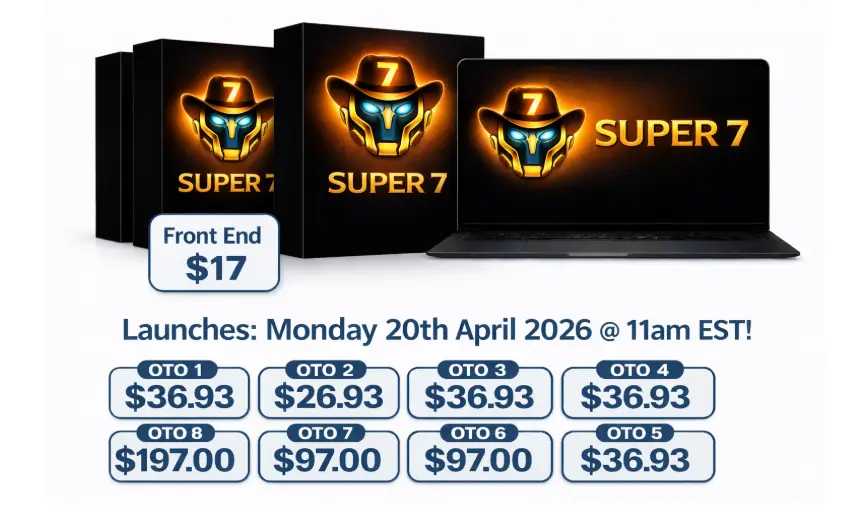
Based on this Super 7 Review research, here’s the complete funnel breakdown:
| Level | What’s Included | Price |
|---|---|---|
| FE — Super 7 | All 7 AI models, OpenClaw engine, commercial license, cloud hosting | $17 |
| OTO 1 — PRO | Unlimited everything, developer license, DFY integration, mobile access | $36.93 |
| OTO 2 — Enterprise | Premium store, Instagram/WhatsApp broadcasting, private cloud storage, encryption | $26.93 |
| OTO 3 — DFY | Done-for-you reviews, affiliate training, commercial rights to 5 apps | $36.93 |
| OTO 4 | (Details TBC at launch) | $36.93 |
| OTO 5 | (Details TBC at launch) | $36.93 |
| OTO 6 | (Details TBC at launch) | $97.00 |
| OTO 7 — Reseller | 100% commissions, marketing pages, members area included | $97.00 |
| OTO 8 — WhiteLabel | Rebrand as your own product, custom domain, passive income | $197.00 |
Cost vs. Value Comparison: Individually, Claude Pro ($20/mo) + Gemini Advanced ($20/mo) + Grok Premium ($16/mo) + Perplexity Pro ($20/mo) alone = $76/month = $912/year. Even with conservative estimates, the FE price of $17 represents significant potential savings if the platform delivers consistent access to these models.
My recommendation on OTOs: For most affiliate marketers, FE + OTO 1 (PRO) is the practical stack. Enterprise and Reseller tiers make sense only if you have an existing client base or plan to actively resell.
Coupon codes available: SUPER5 ($5 off funnel-wide) and SUPER30 (30% off funnel-wide).
Money-Back Guarantee & Risk Reversal
Super 7 comes with a 30-Day Money-Back Guarantee, which means you have a full month after purchase to evaluate the platform in your real workflow and decide if it delivers value for you.
Here’s what the guarantee covers in practical terms: if you purchase Super 7, use it for up to 30 days, and find that it doesn’t work for your needs — whether due to technical issues the support team can’t resolve, or simply because the platform doesn’t deliver as described — you are entitled to a full refund. The process involves contacting the support team at info@help.serapiscode.com. The refund policy is standard WarriorPlus terms, which means you can also raise a dispute through the platform itself if needed.
It’s worth noting a small inconsistency in the guarantee language: the JV page references a “Double Your Money Back Guarantee” while the sales page specifies a standard “30-Day Money Back Guarantee.” Before purchasing, confirm which version applies — and if the Double Money Back Guarantee is genuine, document that claim from the sales page before you buy.
What this guarantee means practically: your financial risk at the $17 FE price is minimal. You have 30 days to run real tasks through the platform — write articles, generate images, test the research tools — and make an informed judgment based on actual results. This means your investment is protected. If it doesn’t work for you, you get your money back. For anyone on the fence, this removes the primary barrier to trying it.
Can It Actually Deliver Results?
The honest answer is: it depends on who’s using it and what they expect.
For a content marketer producing 10–15 pieces of content per week across multiple formats, a working version of Super 7 dramatically reduces production time. If OpenClaw correctly routes image requests to Gemini, research requests to Perplexity, and writing tasks to Claude — and does so reliably — the time saved in tool-switching and manual orchestration alone is worth the FE price many times over.
For a freelancer offering AI-assisted services to clients, the commercial license and multi-model access create a genuine service business foundation. You can charge clients for content, code, images, and research without needing individual subscriptions to each underlying tool. The economics work if the platform is stable and the output quality matches the demo.
Who gets the best results: users who are already comfortable with AI tools and understand prompting well. They’ll immediately know how to leverage the OpenClaw routing, push the boundaries of what each model can do, and build workflows that compound over time.
Who struggles: users who expect automatic results without prompting skill development. AI tools reward good input. If you approach Super 7 as a “set and forget” machine, you’ll be underwhelmed. Those who invest in learning how to prompt effectively will see disproportionately better outcomes.
Comparison With Alternatives
Super 7 vs. Individual Subscriptions (Claude Pro + Gemini + Perplexity)
Where individual subscriptions WIN: you get guaranteed access to the exact, documented model version. You know precisely what you’re working with. API access is available for custom integrations. For developers and advanced users, this clarity is invaluable.
Where Super 7 outperforms: the unified interface eliminates tool-switching. The OpenClaw routing removes the need for model expertise. The one-time fee structure is dramatically cheaper upfront. For non-technical users producing content at volume, this is a meaningful advantage.
Super 7 vs. Similar WarriorPlus AI Aggregators
The WarriorPlus ecosystem has seen several AI aggregator launches. Where Super 7 differentiates itself is the Manus AI integration for autonomous workflows — most competing products in this category don’t include a genuine autonomous task execution layer. If this works as demoed, it’s a real differentiator. This Super 7 Review will be updated post-launch with comparative performance data.
Use-case recommendation: If you’re a non-technical marketer producing content at volume, Super 7 makes sense at the FE price. If you’re a developer or require verified model access for client-facing work, direct API subscriptions are more appropriate.
How to Get the Most From Multi-AI Tools — Even Without Super 7
Whether you buy Super 7 or not, this framework will help you work with multiple AI tools more effectively.
Step 1 — Map Your Tasks to Model Strengths Before you open any AI tool, know what you need. Writing and nuanced text → Claude. Image generation → Gemini or Midjourney. Real-time research with sources → Perplexity. Complex reasoning or math → DeepSeek. Live social media data → Grok. Spend one hour building a personal “AI task map” and you’ll save hours every week.
Step 2 — Build Reusable Prompt Templates The biggest time waste in AI workflows is rewriting the same instructions from scratch every session. Create a folder (Notion, Google Docs, anywhere) with your go-to prompts for recurring tasks. “Write a 1,000-word SEO review article for [PRODUCT] targeting [KEYWORD].” “Generate a product image in [STYLE] with [SPECIFICATIONS].” Save these. Reuse them. Refine them over time.
Step 3 — Use a Sequential Workflow, Not a Simultaneous One Many users try to run too many AI tasks at once and lose track of outputs. Instead, work sequentially: research first (Perplexity or Grok), draft second (Claude or ChatGPT), visual third (Gemini or Midjourney), edit fourth (back to Claude). Each stage feeds cleanly into the next.
Step 4 — Review and Edit Every AI Output This is non-negotiable. No AI tool — not Claude, not Gemini, not anything inside Super 7 — produces publish-ready output 100% of the time. Your human review and editing layer is what separates good content from great content, and it’s what no orchestration engine can replace. Treat AI as a fast first draft, not a final product.
Bonuses
Super 7 comes loaded with both creator-provided bonuses and affiliate-exclusive bonus stacks. The creator bonuses alone carry a stated value of $5,485 and include: the AI Agency Masterclass (a video series on finding and signing AI service clients), the OpenClaw Automation Vault (pre-built “set and forget” workflow scripts for YouTube channels, customer support bots, and more), the One-Click App Builder (turn AI-generated code into sellable apps without coding), the “3 AM Concierge” Script (autonomous settings for ticket and restaurant booking automation), and an Unlimited Commercial License.
Exclusive affiliate bonuses also available include:
- Proteus Cloud App (FE, Pro, ENT & Reseller)
- ProfitShopper Cloud App
- ProfitBildr TikTok Cloud App
- ProfitContent Cloud App
- Flicker Cloud App
- Kash4Watching Cloud App
- ProfitCom Cloud App
- ProfitTV Cloud App
- ACADEMY Cloud App
Frequently Asked Questions
Q1: Does Super 7 really replace $720/month in AI subscriptions?
This is the central claim of the Super 7 Review and it deserves a careful answer. The $720/month figure comes from adding up the premium subscription costs of all seven AI models individually — Claude Pro at $20/month, Gemini Ultra at $20–$250/month depending on tier, Grok Premium at $16/month, Perplexity Pro at $20/month, DeepSeek API usage fees, Microsoft Copilot Enterprise at higher tiers, and Manus AI access. If you were subscribing to each of these separately at their highest configurations, the monthly cost would indeed reach several hundred dollars.
However, the accurate comparison is more nuanced. Most individual users don’t need the highest enterprise configuration of each tool. Free tiers of Perplexity, Claude, and Gemini handle moderate usage. The $720/month figure represents a theoretical maximum, not what most users actually pay. That said, even if you’re paying $60–80/month across three or four subscriptions, Super 7’s $17 FE one-time fee represents a dramatic savings if the platform performs reliably. The key qualifier is “if it performs reliably” — and that’s something only post-launch user data will confirm definitively. My recommendation is to try it during the 30-day guarantee window and make that judgment based on your own real-world usage.
Q2: Is Super 7 legit, or is this just a rebranded ChatGPT wrapper?
This is one of the most important questions for any affiliate AI tool purchase. A “ChatGPT wrapper” in the industry refers to a product that simply puts a new interface on top of the standard OpenAI API without adding meaningful value. Super 7, based on available pre-launch information, appears to be more than that — primarily because of the OpenClaw orchestration layer and the Manus AI autonomous workflow component.
That said, the lack of transparency around the exact model versions being accessed (the “Claude Mythos” and “Gemini 3.1 Ultra” naming doesn’t correspond to official Anthropic or Google product names) means there’s a legitimate open question about what’s running under the hood. If OpenClaw is genuinely routing between real Claude API access, real Gemini API access, and real Grok API access — and not just presenting different prompt configurations of a single model — then it delivers on the multi-AI promise. Based on this Super 7 Review research, the technology concept is sound; the execution is what post-launch users will verify. The 30-day guarantee means you can test this yourself without permanent financial commitment.
Q3: What is the OpenClaw engine and how does it actually work?
OpenClaw is Super 7’s proprietary AI routing system — the intelligence layer that sits between your input and the seven AI models. Think of it as a smart dispatcher. When you type a request, OpenClaw analyzes the nature of the task: is this a creative writing task? A coding task? An image generation task? A research task requiring live data? An autonomous multi-step workflow? Based on that analysis, it routes the request to whichever of the seven AI models is best suited for that specific type of task.
The value of this is significant for users who aren’t AI experts. Currently, getting the best results from the AI ecosystem requires knowing that Claude outperforms ChatGPT for coding, that Perplexity is more reliable for cited research than Grok, and that Gemini is currently the leading model for image-related tasks. Most non-technical users don’t know this, which means they settle for one generalist tool and get average results across all task types. OpenClaw is designed to solve this expertise gap by automating the model selection decision. The quality of OpenClaw’s routing logic — how accurately it identifies task types and how well it handles ambiguous or complex requests — will be the defining factor in whether Super 7 delivers on its core promise. This is the variable I’ll be evaluating most carefully in post-launch testing.
Q4: What happens after the 30-day guarantee period?
Once you’re past the 30-day window, your access to Super 7 continues at the terms of your purchase — one-time fee, no recurring charges at the FE level. The platform is cloud-based, so access depends on Super 7’s servers remaining operational. This is a real consideration with any SaaS product: your access depends on the company staying in business and maintaining their infrastructure. This is not unique to Super 7 — it applies to any cloud tool you use. The LaunchPad team behind this product has an established track record in the WarriorPlus ecosystem, which provides some comfort, but it’s worth noting for long-term planning.
If you encounter technical issues after the guarantee period, the 24/7 support team at info@help.serapiscode.com is your resource. Based on past LaunchPad product launches, support responsiveness has generally been acceptable, though peak launch periods naturally create higher volume.
Q5: Do I need technical skills to use Super 7?
No, and this is one of the platform’s genuine strengths. The entire user experience is built around plain-English input. You type what you need, OpenClaw handles model selection, and the output appears in your dashboard. There is no API key configuration, no prompt engineering expertise required (though it helps), no server setup, and no installation process. From a technical access barrier standpoint, Super 7 is genuinely beginner-friendly.
Where some skill is still helpful: prompting. The quality of what any AI tool produces is directly tied to the clarity and specificity of what you ask for. “Write a blog post about coffee” will produce a generic, forgettable result from even the most powerful AI. “Write a 1,200-word blog post about the health benefits of drinking black coffee for people over 40, in a conversational tone, with section headers, citing 3 specific studies” will produce something actually useful. You don’t need to be technical to develop good prompting skills — you just need practice. Super 7 includes step-by-step training to help users with this, which is a valuable addition to the package.
Final Verdict — Super 7 Review: Should You Buy It?
After thoroughly researching the pre-launch materials, demo content, funnel structure, and AI claims behind this product, here is my honest Super 7 Review conclusion.
The concept is genuinely valuable. Multi-AI orchestration — having the right specialist model handle each task automatically — solves a real problem that content creators, affiliate marketers, and small business owners face daily. At $17, the price is low enough that the risk is minimal and the potential value is significant. For affiliate marketers and non-technical content creators who want a simpler AI workflow without managing multiple subscriptions, Super 7 deserves a serious look. The 30-day guarantee means you can evaluate it in your own workflow with real tasks before making a final judgment.
The concerns are also real and worth naming clearly. The branding inconsistency between “Super 7” and “RemoteAI,” the unverified model naming conventions, and the “dedicated VPS at $17” claim all warrant post-launch verification. Income claims in the sales materials are aspirational, not guaranteed outcomes. This Super 7 Review recommends approaching Super 7 as a productivity tool — not a passive income machine — and evaluating it on the quality and speed of its outputs within your specific workflow.
Who should buy: Affiliate marketers managing content at volume, content creators who need both written and visual output, non-technical business owners who want AI without the learning curve, and freelancers looking for a commercial-licensed multi-AI toolkit at a low entry price.
Who should skip: Advanced developers with custom API workflows, users who require verified, documented model access, and anyone expecting automatic income without active effort and skill development.
Final
You started reading this because you’re tired of paying for multiple AI subscriptions, switching between tools, and still not getting the best possible results. Super 7 was built specifically for that frustration — and at $17, with a 30-day money-back guarantee protecting your investment, the only real cost is the time you spend evaluating it. If it works for your workflow the way the demo suggests it does, you’ll wonder how you managed without it. If it doesn’t, you get your money back. That’s as close to a risk-free test as you’ll find in this space.
Disclaimer
This article may contain affiliate links. If you purchase through these links, I may earn a small commission at no extra cost to you. This does not influence my review — all opinions are based on genuine evaluation of available pre-launch materials, demo content, and funnel documentation.