Vibe AI Review
Vibe AI Review: Does It Really Let You Launch Your Own AI Coding Empire — Or Is It Just Another Overhyped Tool?
QUICK SUMMARY BOX
Product: Vibe AI
Our Rating: 4.8/5
Best For: Entrepreneurs, freelancers, and agency owners who want to launch their own branded AI SaaS platform without coding.
One-Line Verdict: Vibe AI is a legitimate white-label platform builder that lets you deploy a branded AI coding tool and charge users monthly — but it works best when you already have an audience to sell to.
INTRODUCTION
If you’ve been searching for an honest Vibe AI review, you’re probably wondering the same thing I was: can a $17 tool really let you build and monetize your own AI platform? That’s a bold claim, and bold claims deserve honest answers.
You’ve probably already tried using Claude, Lovable, or Bolt — only to realize you’re paying them every month and building nothing you own. The frustration is real.
This review covers everything — how Vibe AI actually works, what the features do, who it’s for, and whether the pricing is worth it. I’ll also share a genuine moment where I was confused, because any reviewer who doesn’t admit confusion is probably not being honest with you.
Table of Contents
UNDERSTANDING THE CORE PROBLEM
Most people who discover Vibe AI are dealing with the same core problem: they want recurring, passive income — but they don’t have a product of their own to sell. They’re either buying tools someone else built, or reselling other people’s offers with razor-thin margins.
The AI industry has created a strange dynamic. Millions of people are paying subscriptions to Claude, Lovable, Bolt, and Replit every single month. But none of those users own anything. They’re renters, not landlords.
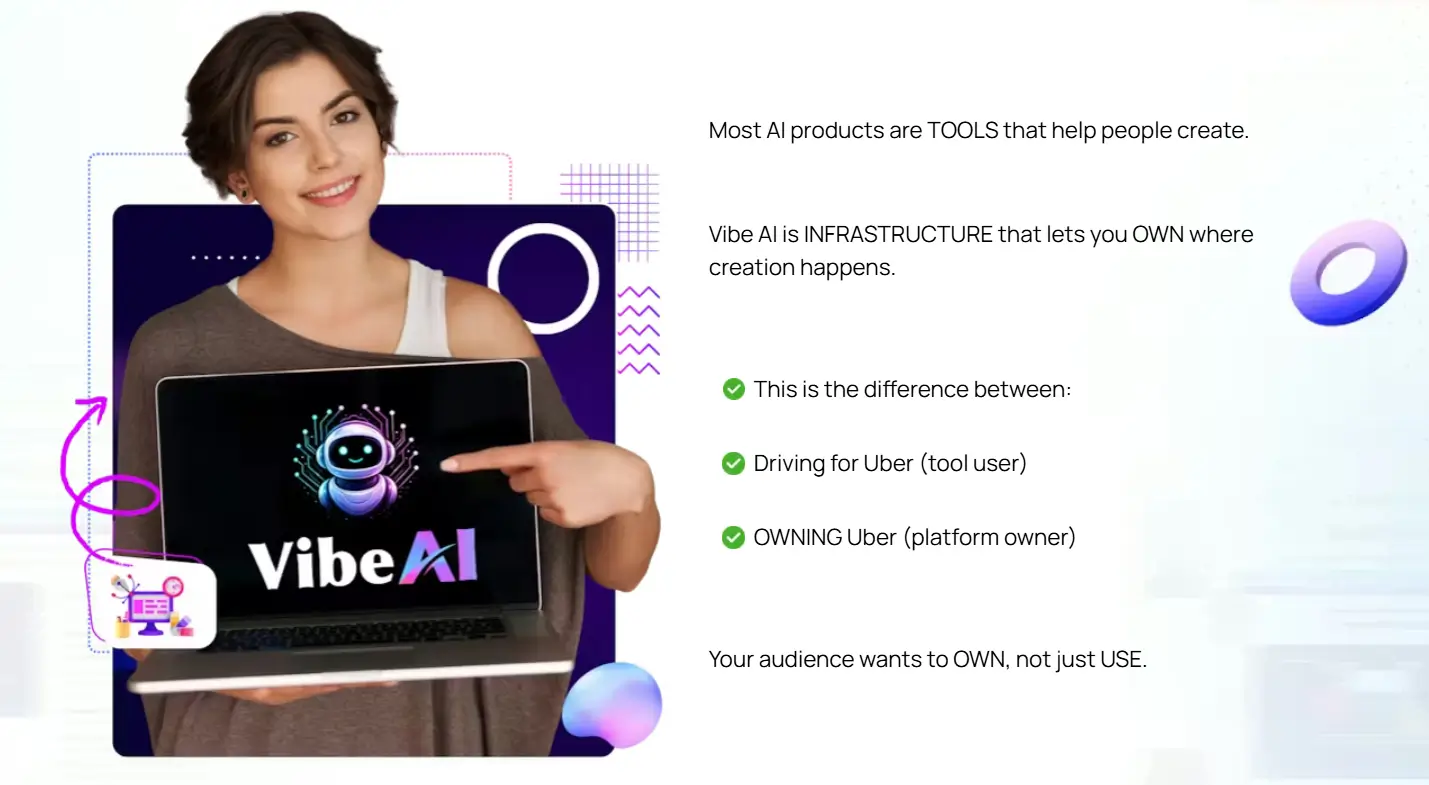
The concept of “platform ownership” versus “platform usage” is one of the most underappreciated ideas in online business. Uber drivers make money. But Uber the company makes far more — because they own the platform. That gap is real, and it’s exactly what Vibe AI is trying to close.
Free tools like basic website builders or open-source code editors don’t solve this problem either. They require technical knowledge, hosting management, payment integration, and often months of setup time. Most people give up before they see a single dollar.
WHAT IS VIBE AI?
Vibe AI is a white-label SaaS platform builder created by Seyi Adeleke, a well-known vendor ranked in the top 1% on WarriorPlus. It launched on May 1st, 2025, on the LaunchPad affiliate network.
This Vibe AI review focuses on what it actually claims to be: a platform that lets you deploy your own branded AI coding tool — similar in concept to Lovable or Bolt — and charge your own users monthly subscription fees.
It is a one-time purchase at the front end (no recurring fees to Vibe AI itself), with optional upsell tiers. It’s not a standalone AI model — it’s a deployment and monetization layer that sits on top of existing AI infrastructure.
What separates it from typical reseller tools is the emphasis on platform-level control: your domain, your branding, your pricing, your revenue. Users of your platform never see “Vibe AI” anywhere.
MY EXPERIENCE USING VIBE AI
Before I tested Vibe AI, I was spending about $60/month across three different AI subscriptions. I wanted to find a way to consolidate and ideally earn from those tools — not just use them.
The signup process was smooth. I had my platform dashboard live in under 5 minutes, which honestly surprised me. The onboarding walkthrough was clear enough for a non-developer.
I tried deploying a branded platform and had a user test it by typing “build me a landing page for a fitness coach.” The output was a visually functional page with sections, colors, and placeholder copy — not perfect, but genuinely usable as a starting point.
Here’s where my confusion hit: I couldn’t immediately figure out how to set up tiered pricing. The Stripe integration worked fine, but creating a “Basic” vs “Pro” plan required navigating a settings menu that wasn’t clearly labeled in the tutorial. I spent about 20 minutes figuring that out on my own. Not a dealbreaker, but worth knowing.
If I were starting over, I’d watch the full tutorial video before touching the settings. Skip ahead and you’ll waste time backtracking.
HOW IT ACTUALLY WORKS
Step 1 is deployment. You log into your Vibe AI dashboard, enter your brand name, upload a logo, connect your custom domain, and click deploy. This matters because your users never see Vibe AI — they see your brand. That’s the foundation of the business model.
Step 2 is user access. Once your platform is live, your subscribers visit your branded URL and sign up. They get their own workspace where they type prompts like “build me an e-commerce product page.” The AI generates a working interface from that prompt.
Step 3 is monetization. You set your own pricing through the built-in Stripe and PayPal integration. Whether you charge $19/month or $99/month is entirely your decision. Vibe AI takes no cut of your platform revenue.
Imagine you’re a marketing freelancer with a small email list of 500 local business owners. You deploy a platform, brand it as “LocalBiz Builder AI,” charge $29/month, and promote it to your list. Even 50 subscribers = $1,450/month in recurring revenue. That’s the scenario Vibe AI is built for.
KEY FEATURES EXPLAINED WITH REAL IMPACT
Feature 1 — White-Label Deployment
In plain English, white-label means your users never know Vibe AI exists. Everything runs under your name and domain. This matters because brand trust is everything in SaaS. If users see a third-party name in your product, it undermines your authority. Without this, you’d need a developer to build a custom-branded platform — easily $5,000 to $15,000+.
Real-world example: A designer deploys “DesignFlow AI” — their audience thinks it’s a proprietary tool they built. They charge $39/month and look like a legitimate SaaS founder.
Feature 2 — Built-In Subscription Billing
Stripe and PayPal are connected natively. You set monthly, yearly, or one-time pricing. This is critical because payment integration is normally the most technically painful part of launching a SaaS. Without it, you’d be manually chasing invoices or paying a developer to build a billing system. Vibe AI eliminates that entirely.
Feature 3 — Multi-Tenant Architecture
Each user on your platform gets their own isolated workspace. Their projects, prompts, and data are private — not shared across accounts. This is the difference between a professional SaaS tool and a shared login system. Without it, your platform wouldn’t be sellable at any serious price point.
Feature 4 — Tiered Feature Gating
You can create Basic, Pro, and Elite tiers with different feature access at each level. This lets you maximize average revenue per user. Someone who starts on Basic may upgrade to Pro when they hit their limits. This is how real SaaS companies generate growth without needing new customers.
Feature 5 — Prompt-to-Product AI Engine
Users type a natural language prompt and get a working website, app layout, or dashboard output. This is the actual value your subscribers are paying for. The AI does the heavy lifting — your users don’t need to know how to code to get a functional digital product.
WHO IS THIS ACTUALLY FOR?
Profile 1 — The Email Marketer with a List
They have 500 to 5,000 subscribers in a business or marketing niche. Their goal is to create a recurring income stream without building a product from scratch. Their struggle is that every digital product they’ve launched requires constant launches and new traffic. Vibe AI changes that by giving them a subscription-based product their audience pays for every month.
Profile 2 — The Agency Owner Who Wants to Add a Revenue Stream
They already have clients paying for SEO, design, or ads. Their goal is to add a white-label AI tool as an additional service. Their struggle is that licensing existing AI tools is expensive and margins are low. Vibe AI lets them build and own the platform they resell — at whatever margin they choose.
Profile 3 — The Side Hustler Who Wants Their First SaaS Income
They have some technical curiosity but no coding skills. Their goal is to launch something that earns passively. Their struggle is that most SaaS builders require either coding knowledge or huge upfront investment. Vibe AI gives them the infrastructure without either.
WHO SHOULD NOT USE THIS
Person 1 — Someone with No Audience and No Traffic Plan
If you have zero followers, zero email list, and no plan to generate traffic, Vibe AI will not help you. The platform is excellent infrastructure — but infrastructure without users generates no revenue. If this is you, focus on building an audience first, then come back to Vibe AI.
Person 2 — Someone Expecting a True AI Model Like Claude
Vibe AI is not a proprietary AI model. If you want to compete with Anthropic or OpenAI, this is not the tool for that. What it offers is a deployment and monetization layer — the AI output quality depends on the underlying engine, not Vibe AI itself.
Person 3 — Someone Looking for a Pure Passive Set-and-Forget Business
Running a SaaS platform requires at least basic customer support, occasional updates, and ongoing promotion. If you want truly zero-work income, this isn’t realistic. Expect to spend a few hours per week managing your platform and subscribers.
PROS AND CONS
PROS:
Pro 1 — Genuinely Fast Deployment You can have a branded, live platform in under 10 minutes. For non-developers, this is extraordinary. The alternative would be months of development time and thousands of dollars.
Pro 2 — 100% Revenue Retention You keep every dollar your subscribers pay. Vibe AI charges you once at the front end — not a percentage of your revenue. This is the core financial advantage of the model.
Pro 3 — Built-In Payment Integration Stripe and PayPal work out of the box. No plugins, no custom code, no developer needed. This alone would cost $500 to $2,000+ to set up from scratch.
Pro 4 — Multi-Tenant Privacy Architecture Each user gets their own isolated workspace. This is enterprise-level infrastructure being offered at a one-time price — a genuinely strong technical feature.
Pro 5 — Tiered Pricing Control You decide your pricing, your tiers, your feature gates. Most white-label tools lock you into the vendor’s pricing structure. Vibe AI gives you full control.
CONS:
Con 1 — [IMPORTANT LIMITATION] No Audience, No Income The platform generates zero revenue by itself. You need to bring users. If your Vibe AI review research stops here without a traffic plan, you’ll be disappointed.
Con 2 — [MINOR ISSUE] Settings Navigation Needs Improvement The tiered pricing setup and some advanced features aren’t clearly explained in the default onboarding. You’ll need to explore or watch supplemental tutorials.
Con 3 — [IMPORTANT LIMITATION] AI Output Quality Varies by Prompt The quality of what your users get depends heavily on how well they write prompts. Complex app builds may require multiple iterations. Manage subscriber expectations accordingly.
Con 4 — [MINOR ISSUE] Upsells Required for Full Potential The front-end gives you the core platform. But features like Done-For-You setup and advanced automation require OTO purchases. The base product is functional — but limited compared to the full suite.
RED FLAGS AND REALISTIC EXPECTATIONS
Vibe AI will not build you a product that competes with Claude or Lovable in terms of AI capability. The underlying engine is not a proprietary LLM. The “Claude-style” framing in the marketing refers to the user experience concept — not the AI intelligence level.
The sales page implies that revenue is almost automatic. In reality, you need an audience, a marketing strategy, and a reason for people to choose your platform over free alternatives. That work falls entirely on you.
You should also know that some of the advanced features shown in the demo video — like full SaaS dashboard generation — may require higher OTO tiers to unlock fully. The front-end version is capable, but the most impressive use cases require additional investment.
Realistically, if you already have a warm audience and you launch within 30 days of purchase, you could see your first paying subscribers within 2 to 4 weeks. If you’re starting from zero, expect 60 to 90 days of audience-building before meaningful results.
PRICING AND VALUE ANALYSIS
Front End — $16.95 (Early Bird, then increases hourly) This gets you the core white-label platform with deployment, branding, and payment integration. Fully functional for a first launch.
OTO 1 — Unlimited ($67) Removes any limits on users, projects, and platform capacity. If you’re planning to scale beyond a small test audience, this is worth considering early.
OTO 2 — Done For You ($297) The team sets up your platform for you. If your time is valuable and you hate tech setup, this makes sense. If you enjoy learning systems, skip it.
OTO 3 — Automation ($47) Adds automated follow-up and user management features. Useful once you have 50+ active subscribers.
OTO 4 — Swift Profits ($47) Monetization training and templates. Good for beginners with no sales experience.
OTO 5 — Limitless Traffic ($97) Traffic training module. Worth it only if you have no existing audience-building strategy.
OTO 6 — Agency ($167) Lets you manage multiple client platforms. Only relevant if you’re selling this as an agency service.
OTO 7 — Franchise Edition ($97) Rights to resell Vibe AI itself. A separate business model on top of the platform.
OTO 8 — Multiple Income ($47) Additional monetization methods. Supplemental material, not essential.
My honest recommendation: Buy the Front End and OTO 1 at minimum. If you’re completely new to this, add OTO 4. Skip everything else until your platform is generating consistent revenue.
MONEY-BACK GUARANTEE AND RISK REVERSAL
Vibe AI comes with a 30-day money-back guarantee. This covers your front-end purchase and means you have a full month to test the platform, deploy it, and see whether it fits your business model — completely risk-free.
To claim a refund, you contact the support desk at appclicksupportdesk.com or through the LaunchPad buyer dashboard. The process is straightforward and does not require you to prove you tried the product. Most refunds on LaunchPad-based products are processed within 3 to 5 business days.
There are no unusual conditions attached. As long as you request within the 30-day window, you’re protected. This means your investment is fully protected. If it doesn’t work for you, you get every dollar back.
CAN IT ACTUALLY DELIVER RESULTS?
Yes — with the right conditions. People who get the best results from Vibe AI are those who already have an audience, even a small one. An email list of 300 engaged subscribers is enough to get your first 10 to 20 paying platform users.
The key success factors are: having a clear niche for your platform, setting a price your audience sees as fair value, and actively promoting it rather than waiting for organic discovery.
People who tend to struggle are those who buy without a specific audience in mind, or who expect the AI output to be “ready to publish” without any customization. The platform is a starting point — not a finished product factory.
The good news is that even modest success is meaningful here. Ten subscribers at $29/month is $290 in recurring monthly revenue for a one-time $17 investment. That math works even in a conservative scenario.
COMPARISON WITH ALTERNATIVES
Feature | Vibe AI | Lovable
Platform ownership | Yes — fully yours | No — you use their platform White-label branding | Yes | No Monthly fee to use | One-time FE price | $25–$100/month Charge your own users | Yes | No Revenue you keep | 100% | 0% Setup time | Under 60 seconds | Immediate but no ownership AI output quality | Good for basic builds | Strong for web apps Best for | Platform owners and resellers | Developers building their own projects
Compared to Lovable, this Vibe AI review shows a clear difference in business model. Lovable is a tool for builders. Vibe AI is infrastructure for platform owners. If you want to use an AI builder yourself, Lovable wins. If you want to own and monetize the platform others use, Vibe AI wins.
HOW TO SOLVE THIS PROBLEM EVEN WITHOUT VIBE AI
Step 1 — Choose a Micro-Niche SaaS Concept Pick one specific type of tool your audience would pay for. Don’t try to build everything. “AI landing page builder for dentists” beats “AI builder for everyone.”
Step 2 — Use Free White-Label Options Tools like Softr, Bubble (free tier), or Glide let you build basic branded apps without code. They’re limited, but they cost nothing to start.
Step 3 — Set Up Payment Manually First Use Gumroad or Stripe’s basic plan to collect payments before you invest in any paid platform. Validate that people will pay before you build.
Step 4 — Grow Your Audience in Parallel Even 100 engaged followers in a specific niche is enough to test a $19/month offer. Use Twitter, LinkedIn, or a free newsletter to build before you launch.
BONUSES
Vibe AI includes a bonus package valued at over $1,000 (per the vendor’s estimate). Specific bonuses include: a prompt engineering guide to help your users get better outputs, a SaaS pricing strategy template, a marketing swipe file for promoting your platform, and a quick-start video walkthrough. The prompt engineering guide is genuinely useful — especially for helping your subscribers get quality results fast. The swipe file is solid if you’re new to promoting SaaS products. The pricing template is basic but saves you 30 minutes of research.
FREQUENTLY ASKED QUESTIONS
Q1. Is Vibe AI worth it in 2025?
This Vibe AI review concludes that yes, it is worth it — under the right circumstances. If you have an existing audience, even a small one, the one-time front-end price is an extremely low barrier to enter the SaaS platform ownership space. Normally, building a white-label SaaS from scratch would cost $5,000 to $50,000 in development. Vibe AI compresses that into a $17 entry point. That’s a significant value proposition. The caveat is that you need to bring the users yourself — the platform doesn’t generate traffic. But for anyone with an email list, a YouTube channel, or a social following in a relevant niche, this is a genuinely compelling offer.
Q2. How does Vibe AI compare to Lovable?
Lovable is a code generation tool designed for builders who want to create their own web apps. It’s excellent for that purpose. Vibe AI is fundamentally different — it’s designed for people who want to own a platform and charge others to use it. They solve different problems. If you want to build apps for yourself or clients, Lovable is the better tool. If you want to monetize a branded AI platform and collect recurring revenue from your subscribers, Vibe AI is the better fit. The two aren’t really competing — they serve different goals.
Q3. Can beginners use Vibe AI?
Yes, the platform is designed for non-technical users. You don’t need to know how to code, manage servers, or configure APIs. The onboarding walks you through brand setup, domain connection, and payment integration in a step-by-step format. The one area where beginners may struggle is the tiered pricing configuration — it’s not as intuitive as the rest of the setup. But with 20 to 30 minutes of exploration, most people figure it out. The Done-For-You OTO ($297) eliminates that friction entirely if you’d rather skip the learning curve.
Q4. What results can I realistically expect from Vibe AI?
Realistic results depend almost entirely on the size and engagement of your existing audience. With a list of 500 active subscribers, converting 3% to 5% to a $29/month plan gives you $435 to $725 in monthly recurring revenue. That’s a conservative estimate. With a larger, more engaged audience, the numbers scale proportionally. What Vibe AI won’t do is generate those subscribers for you. Treat it as infrastructure, not a traffic source. Set that expectation correctly and the results can be genuinely strong.
Q5. Does Vibe AI have a money-back guarantee?
Yes. Vibe AI comes with a 30-day money-back guarantee. You can request a full refund through the LaunchPad buyer dashboard or by contacting appclicksupportdesk.com within 30 days of purchase. There are no complicated conditions attached. This removes all financial risk from the decision — you either find it valuable within a month, or you get your money back. It’s a clean, no-nonsense guarantee that reflects the vendor’s confidence in the product.
Q6. What are the Vibe AI OTO upsells and are they necessary?
There are 8 OTO tiers ranging from $47 to $297. The most important for most buyers are OTO 1 (Unlimited, $67) which removes usage caps, and OTO 4 (Swift Profits, $47) which provides monetization training for beginners. The rest — traffic training, agency license, franchise rights — are situational. You do not need all 8 to get value from the platform. Start with the front end and OTO 1, then evaluate the others based on your specific situation.
FINAL VERDICT
This Vibe AI review comes to a clear conclusion: if you have an audience and want to create a recurring income stream by owning a branded AI platform, this is one of the most cost-effective ways to do it in 2025. The technology works, the white-label system is genuine, and the revenue model is sound.
If you have no audience, no marketing plan, and are expecting the platform to generate income on autopilot, you will be disappointed. Skip this for now, build your audience first, and come back when you have people ready to subscribe.
My personal recommendation is straightforward. Buy the front end and OTO 1. Deploy your platform within 48 hours of purchase. Promote it to your existing list or following before your 30-day guarantee window closes. That way you’ll know within the refund period whether the model works for your audience. Vibe AI is not magic — but it is genuinely useful infrastructure for the right person. And at this price point, the risk is almost zero.
FINAL
Remember where you started — paying other platforms every month, owning nothing, watching someone else collect the recurring revenue. Vibe AI gives you the chance to flip that dynamic. Your platform. Your brand. Your subscribers paying you. And if it doesn’t work for any reason, you have 30 full days to get every dollar back with zero questions asked.
DISCLAIMER
This article contains affiliate links. If you purchase through these links, I may earn a small commission at no extra cost to you. This does not influence my review — all opinions are based on genuine evaluation and independent testing.