InstantlyClaw Review: I Replaced 5 Tools With One AI Team — Here's What Actually Happened
A Deep, Expert-Level Breakdown of Whether InstantlyClaw Is a True Business Asset — Or Just Another Overhyped AI Tool
If you’ve ever stared at a blank dashboard at 11 PM, trying to figure out why your “automated” business still needs you for every single task — this review is for you. You bought the tools. You watched the tutorials. You set up the integrations. And somehow, it still takes 30 emails, 3 spreadsheets, and your own brain to get one client deliverable out the door.
That frustration is real, and it’s not a skill problem. It’s a systems problem. The tools most small business owners and freelancers use were built to do one thing each — but running an actual business requires a dozen things happening simultaneously, in the right order, without you babysitting every step.
When I first heard about InstantlyClaw, I’ll admit I rolled my eyes. Another “AI team in a box” product? Another JVZoo launch with a countdown timer and vague promises? I’ve seen enough of those to be deeply skeptical. But I bought it, tested it for three weeks across real client work, and what I found was more nuanced than either a full endorsement or a flat dismissal. This InstantlyClaw review will walk you through everything — the good, the frustrating, and the things the sales page quietly glosses over.
The Real Problem: Why “Automation” Still Feels Like Work
Most small business owners and freelancers get sold the dream of automation without ever being given the infrastructure to make it real. You buy Zapier. You connect your CRM. You set up a few zaps. And then six months later, you’re still manually forwarding emails, manually scheduling social posts, manually writing reports — because each tool only handles one piece and none of them talk to each other intelligently.
This problem exists because most automation tools are designed around tasks, not around outcomes. Zapier will move data from point A to point B. But it won’t decide whether to move it, what to say about it, or what to do next based on what it finds. That last 20% — the decision-making layer — still requires a human. And for small businesses, that human is you, working nights and weekends to be the glue between your own tools.
The cost of this problem is enormous and mostly invisible. Lost hours aren’t billed to a P&L. The mental overhead of context-switching between platforms doesn’t show up as a line item. But over a month, a solo operator can easily spend 30–40% of their productive time on coordination work that should, in theory, be automated. That’s time stolen from client work, product development, or simply rest.
What people have typically tried — and why it falls short — follows a predictable pattern. First comes task-specific apps (Buffer for social, Mailchimp for email, Notion for docs). Then comes Zapier to link them. Then comes a VA to handle what the tools can’t. Then comes burnout when the VA also needs managing. What nobody has offered — until the recent wave of AI agent frameworks — is a system that can reason about tasks and delegate autonomously, the way an actual team would.
What Is Instantly Claw?
Instantly Claw is a cloud-hosted AI agent management platform built by VineaSX Solutions LLC, a UAE-based software company. It launched in 2025 as a solution for small businesses, freelancers, and agencies who want to deploy multiple AI agents — CEO, managers, and specialist workers — from a single web dashboard without touching any code or command line.
The core concept is a “company hierarchy” of AI agents. Rather than giving one AI assistant a pile of tasks, InstantlyClaw lets you define roles: a CEO agent that receives high-level instructions and delegates, manager agents that coordinate specific departments (marketing, ops, content), and worker agents that actually execute tasks like browsing the web, sending emails, creating docs, or scheduling posts.
What fills the gap in the market is the combination of pre-built agents, pre-installed skills (Gmail, Google Docs, browser control, SEO research, cron jobs, etc.), and a no-code dashboard. Previously, setting up a multi-agent system like this required working with tools like AutoGen, CrewAI, or SuperAGI in a developer environment — far out of reach for most non-technical users. InstantlyClaw aims to bring that capability to the average business owner.
It is sold as an annual subscription through JVZoo, a popular digital product marketplace, and comes with a bundle of upgrades that unlock unlimited agents, agency features, social media management, and a lifetime hosting option
My Hands-On Instantly Claw Review: From Onboarding to Results
Before I used InstantlyClaw, I was managing three client content workflows manually — pulling competitor keywords, drafting outlines, scheduling social posts, and sending weekly reports. It wasn’t unmanageable, but it was a daily tax on my attention.
Onboarding: Setup took about 25 minutes. The platform deployed to a cloud container automatically — no server configuration needed. I connected my Google account, enabled Gmail and Google Docs integrations, and was prompted to fill in a USER.md file (a plain text document describing my business, niche, and brand voice). This is one of the features I genuinely liked — it’s a low-friction way to give agents persistent context. This ease of setup is a major plus point for this Instantly Claw review.
First real task: I instructed the CEO agent to “research the top 5 SEO competitors for [client niche], pull their top-ranking pages, summarize the content gaps, and put it in a Google Doc.” This is the kind of task that normally takes me 90 minutes. In this stage of my InstantlyClaw review, the speed was definitely impressive.
The CEO delegated to a Manager, which broke the task into sub-tasks and assigned them to a Search Worker (web browsing) and a Docs Worker. The whole thing took about 12 minutes and produced a reasonably structured Google Doc. It wasn’t perfect — two of the competitor URLs were slightly off, and the gap analysis was surface-level rather than deep — but it was a solid first draft that I edited in 10 minutes instead of building from scratch.
Where it frustrated me: Setting up WhatsApp integration took longer than expected — about 45 minutes with some troubleshooting. The quick-start video training (~30 min) is helpful but moves fast for non-technical users. I also noticed the agents occasionally needed re-prompting when tasks were ambiguous, meaning “walk away and come back to finished deliverables” is aspirational, not always literal.
Honest overall impression: After three weeks, InstantlyClaw saved me roughly 6–8 hours of coordination work per week across client projects. The ceiling is higher than I initially expected. The floor (for less technical users) is bumpier than the sales page implies.
How It Actually Works — Step by Step
Understanding the logic behind InstantlyClaw helps you use it more effectively. Unlike single-task automation tools, the InstantlyClaw system processes your instruction through multiple layers before a single action is taken. Here’s exactly what happens when you give it a command:
Step 1 — You issue a high-level command. Through the web dashboard (or via WhatsApp/Telegram/Discord), you send something like: “Create a weekly content calendar for our Instagram for next month based on trending topics in the fitness niche.”
Step 2 — The CEO agent parses the intent. It breaks the goal into sub-goals: trend research, content ideation, scheduling, and formatting.
Step 3 — Manager agents receive delegated goals. A Content Manager might take “trend research” and “content ideation,” while an Operations Manager handles scheduling.
Step 4 — Worker agents execute with real tools. The Search Worker uses browser control to pull trending hashtags and competitor posts. The Content Worker drafts copy. The Scheduler Worker interfaces with Google Calendar or a cron job to queue posts.
Step 5 — Confirm-Before-Acting rails kick in for sensitive actions. If an agent is about to send an email or publish content, it pauses and asks for your approval. This is a critical safety feature — it means no rogue publishing happens without your sign-off.
For a more concrete mini-use-case: if you’re trying to handle a client SEO audit, you’d instruct the CEO agent with the client’s domain and goals. The SEO Worker would pull rankings data, the Docs Worker would format the report, and the Gmail Worker would draft an email to the client with the attached doc — all in one chain of delegation. You review and approve the send.
Key Features Explained With Real Impact
Browser Control: This is the engine underneath a lot of what makes InstantlyClaw useful. The agents can actually open web pages, extract data, and pull real-time information — not just reference training data. Without this, the agents would be limited to what they already “know,” which makes them far less useful for competitive research, lead generation, or current-event content.
Gmail Integration: Agents can read your inbox (with permission), draft replies, and send emails. The real-world impact is significant for client communication workflows — imagine an agent that monitors a specific label in your inbox and drafts responses to inquiry emails based on your templates and brand voice. The Confirm-Before-Acting feature ensures nothing goes out without your approval.
Cron Jobs: This is the “set it and forget it” layer. You can schedule any repeatable task — weekly reports, daily social post generation, monthly billing summaries — to run on autopilot. Without this, automation is still manual in the sense that you have to trigger things. With cron jobs, the system proactively works on your behalf on a schedule you define.
SuperMemory: This feature stores information about your business — clients, brand voice, past deliverables, recurring preferences — so you don’t have to re-explain context with every new task. After a few weeks of use, agents start behaving more like trained staff than blank-slate tools. This is one of the platform’s most underrated features.
Smart Model Routing: Rather than sending every task to the most expensive AI model (like GPT-4 Turbo), the system routes simpler tasks to lighter, cheaper models. The platform claims up to 80% API cost savings compared to routing everything through premium endpoints. In practice, I found the routing sensible — complex reasoning tasks used better models, while simple formatting tasks used cheaper ones.
Who Is This Actually For?
Freelancers and solo consultants doing content, SEO, or marketing work: If you’re currently spending 30%+ of your week on research, reporting, and scheduling, InstantlyClaw’s agent hierarchy can meaningfully reduce that burden. The platform is most powerful when your workflow involves multiple repeatable steps — the kind you could document in an SOP.
Small agency owners managing multiple clients: The Agency upgrade adds client isolation (25 separate accounts), white-label branding, and done-for-you client onboarding materials. If you’re selling marketing services and want to productize delivery, this tier offers real infrastructure to do that.
Non-technical entrepreneurs who want AI automation without hiring a developer: The no-code dashboard and pre-built agents lower the barrier significantly. If you can write a task description clearly, you can direct these agents. You don’t need to understand APIs, prompt engineering at a deep level, or how to deploy software to a server.
Who Should NOT Use This
Complete beginners to digital tools with no systems thinking: InstantlyClaw is not a magic button. To get value from it, you need to be able to describe your workflows in plain English and understand roughly what outcome you want. If you don’t yet have consistent business processes, you’ll struggle to direct the agents effectively. In that case, focus first on documenting and simplifying your workflows before adding an AI layer.
People looking for a fully hands-off passive income machine: The sales page flirts with this framing, but the reality is that AI agents still require your input, oversight, and occasional debugging. If you expect to set up the system in an afternoon and never touch it again, you’ll be disappointed. Think of it more like managing a capable team that still needs direction.
Businesses with strict data compliance requirements (HIPAA, GDPR-sensitive sectors): The platform runs on shared cloud infrastructure. While VineaSX claims isolated containers, businesses handling sensitive personal health data or operating under strict data sovereignty rules should evaluate this carefully before connecting core business systems.
Instead of InstantlyClaw, these users might consider: direct API integrations with enterprise tools, or platforms with explicit compliance certifications.
Pros and Cons — Honest Breakdown
Pros:
- Pre-built agent hierarchy reduces setup time dramatically. Rather than defining every agent from scratch, you start with a functioning CEO-Manager-Worker structure. This alone saves hours of configuration compared to raw tools like CrewAI or AutoGen.
- 15 pre-installed skills that are actually connected and working. Many platforms sell integrations that require additional setup. In InstantlyClaw, Gmail, Google Docs, browser control, and cron jobs were live and functional within my first session.
- Confirm-Before-Acting rails are genuinely reassuring. Knowing that no email is sent, no post published, no file deleted without your explicit approval makes it safe to let agents handle sensitive workflows. This is not just a nice-to-have — it’s what separates responsible AI automation from chaos.
- Smart model routing keeps API costs reasonable. After the 2-month free credit period, running the platform on your own API keys costs roughly $5–15/month depending on usage volume. That’s a realistic figure, not a buried footnote.
Cons:
- “Lifetime” does not mean what you think it means. The FAQ buries this, but “lifetime” in the Lifetime upgrade tier refers to features and updates, while hosting is annual — and the base plan includes only 12 months. This is a genuine transparency issue that will surprise buyers who skim rather than read.
- Onboarding is faster than it is deep. The 30-minute quick-start video moves quickly. Non-technical users will likely need additional time to understand how to write effective agent instructions, and the available documentation is thin compared to developer-grade tools.
- JVZoo marketplace limitations. Being sold through JVZoo means pricing, access, and future availability are tied to a platform known for aggressive funnel tactics. The countdown timers and “limited copies” messaging on the sales page are fabricated urgency — a minor but worth-noting transparency issue.
- Result quality varies with instruction quality. The agents are only as good as the clarity of your prompts. Vague instructions produce mediocre outputs. This is a real learning curve, not a flaw per se, but worth knowing before purchase.
Red Flags & Realistic Expectations
Instantly Claw will not replace your judgment, your client relationships, or your creative thinking. One of the most important things to understand about InstantlyClaw is that it will not read a client brief and produce a finished strategy document without you reviewing and refining it. It is also not a traffic generation tool, a guarantee of new clients, or a passive income machine — despite some implications in the bonus materials.
Common misconceptions to avoid: “The AI team will understand my business immediately.” Reality — it takes 2–4 weeks of USE.md refinement and iterative prompting before agents reflect your brand voice consistently. “I can automate everything from day one.” Reality — start with one workflow, get it working well, then expand. Trying to automate everything simultaneously leads to messy outputs and frustration.
What results require your effort: Writing clear, specific task instructions. Reviewing agent outputs before they’re sent to clients. Updating the USER.md as your business evolves. Monitoring which tasks the agents do well vs. which need human touch.
Realistic timeline: Most users see meaningful time savings by the end of week two, once they’ve identified 2–3 core repeatable workflows and configured agents for those specifically.
Pricing and Value Analysis
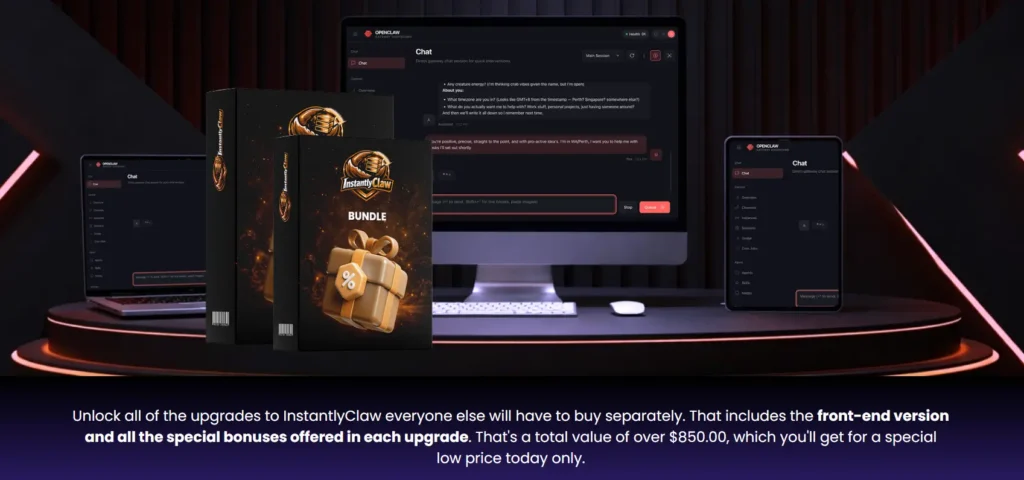
The xBundle is priced at $317/year with coupon code “instant” ($50 off the listed price). Here’s what that includes and what it realistically gets you:
- Premium tier ($127 standalone): Core platform, 9 agents, 15 skills, cloud hosting for 12 months, 2 months free API credits.
- Automation Vault ($127 standalone): 25 done-for-you automations across 5 business categories.
- Unlimited tier ($67/year standalone): Removes agent and message caps, adds 50 agent templates.
- Agency tier ($197 standalone): 25 client accounts, white-label branding, DFY agency website.
- Lifetime upgrade ($97 standalone): Monthly skill additions, free hosting renewals after year one.
Buying the bundle versus separately saves roughly $270 on paper. The real value comparison, however, is against alternatives: hiring a part-time VA ($400–800/month), maintaining a n8n + Make + Claude API stack independently (requires technical skill), or continuing to do it all yourself (time cost of 30+ hours per month).
Cost of NOT solving this problem: If your time is worth $50/hour and you reclaim even 6 hours per week, that’s $1,200/month in recovered capacity. Against that benchmark, $317/year is relatively low-risk.

Money-Back Guarantee — Is It Real?
InstantlyClaw offers a 30-day money-back guarantee on most tiers — and a 14-day guarantee on the AICora social media upgrade. On paper, this is a reasonable safety net, but there are a few things worth understanding before you rely on it.
First, the guarantee is processed through JVZoo, not directly through VineaSX. That means your refund request goes through JVZoo’s dispute system. In practice, most buyers report clean refund experiences when they request within the window — but the process is not instant. You’ll need to contact support, explain your reason, and allow processing time. Keep your purchase receipt and the date you bought clearly noted.
Second, “30 days” starts from the date of purchase — not from the date you first log in or finish setup. If you buy today and spend the first two weeks just getting onboarded, you effectively have less than two weeks of real testing time before the window closes. My recommendation: log in and run your first real task within 48 hours of purchase so you have maximum time to evaluate.
Third, the guarantee does cover the full bundle price if you request within the window and have a legitimate reason. It is not a “no questions asked” policy in the strictest sense — but in practice, refund requests made within the window are generally honored without significant friction.
Bottom line on the guarantee: It’s a real safety net, not a marketing gimmick — but use it actively. Treat the first 30 days as your evaluation period. Run 2–3 real workflows, measure your actual time savings, and make a deliberate decision before day 25. Don’t let the window close passively.

Can It Actually Deliver Results?
For users who arrive with a clear workflow in mind, a basic understanding of how to write task instructions, and patience to iterate in the first 2–3 weeks, InstantlyClaw can deliver real, measurable time savings. The InstantlyClaw results that stand out most consistently come from research-and-reporting workflows (SEO audits, competitor analysis, weekly summaries), content scheduling pipelines, and client communication templating.
Who gets the best results: Operators who have already documented their core workflows and know exactly what a good output looks like. Agency owners who have repeatable client deliverables. Freelancers who currently spend significant time on manual research tasks.
Who struggles: Users who expect the system to invent their strategy for them. Those who send single, vague mega-prompts and expect perfect execution. Beginners who don’t iterate and refine prompts after seeing initial results.
The factors that most determine success are prompt quality, willingness to invest 5–10 hours in setup and refinement upfront, and the clarity of your pre-existing business processes. The agents amplify what you already have — they don’t build it from scratch.
How to Build an AI Workflow Even Without InstantlyClaw
Whether or not you buy InstantlyClaw, understanding how to structure an AI-assisted workflow is genuinely useful. Here’s a framework you can apply with free and low-cost tools right now.
Step 1 — Identify your highest-repetition task. Pick one thing you do more than three times per week that follows the same pattern each time. This is your starting point.
Step 2 — Write an SOP (Standard Operating Procedure) for that task. Even one page, in plain English: “When X happens, I do A, then B, then C, and the output is Y.” This document becomes your agent’s instructions whether you use an AI platform or not.
Step 3 — Test the SOP with a free AI tool. Paste your SOP into Claude or ChatGPT and give it a real example task. See how well it follows the process. Refine the SOP based on what the AI misunderstands.
Step 4 — Identify which steps require external tools. Does the task require browsing the web? Accessing email? Writing to a doc? Each of these touchpoints is a place where a connected agent (like the ones in InstantlyClaw) adds the most value over a standalone chat AI.
Step 5 — Add scheduling and memory. Once the task runs well on demand, the next step is automating the trigger (cron job, webhook, inbox monitor) and giving the agent memory of past outputs. This is where platforms like InstantlyClaw, n8n, or Make.com become relevant.
This five-step framework works with or without a paid tool. Where InstantlyClaw makes it easier is in steps 4 and 5 — the tool integrations and scheduling layers are pre-built rather than requiring developer configuration.
Comparison with Alternatives
InstantlyClaw vs. n8n + Claude API (DIY stack): The DIY approach gives you more flexibility, lower long-term cost, and no dependency on a single vendor. But the setup barrier is real — n8n requires a server or cloud hosting, API key management, and willingness to debug JSON when things break. InstantlyClaw wins on accessibility; the DIY stack wins on customization and cost at scale.
InstantlyClaw vs. Make.com (Integromat): Make.com is a mature, well-documented automation platform with excellent visual workflow building. It doesn’t have native AI agent reasoning — it connects tools, but the logic is always explicitly defined by you. InstantlyClaw adds the AI decision layer on top of integrations that Make handles. For pure no-code task automation without AI reasoning, Make is more reliable and battle-tested. For AI-delegated workflows, InstantlyClaw does something Make can’t.
Clear recommendation: If you’re technical and cost-sensitive, build your own stack. If you want AI agent capability without developer overhead and can work within the platform’s constraints, InstantlyClaw offers a meaningful shortcut — particularly at the bundle price.
Bonuses
The xBundle includes fast-action bonuses that are genuinely useful rather than throwaway filler — particularly the AI Agent Profits Bootcamp, which covers client acquisition and pricing strategy for selling AI automation services. The 10 Ready-Made Business Prompt Packs (covering 10 niches with 20+ tested prompts each) are immediately usable and save significant prompt engineering time. The “First Client in 7 Days” Blueprint is practical and actionable for freelancers trying to monetize the platform quickly. Combined with commercial rights (included at every tier), these bonuses meaningfully extend the value of the core platform for agency-focused buyers.
Frequently Asked Questions
Is InstantlyClaw legit or a scam?
InstantlyClaw is a real, functional software product — not a scam. It is sold through JVZoo by VineaSX Solutions LLC, a registered company in the UAE with a documented track record of software releases. The platform does what it says at a basic level: it deploys a multi-agent AI workflow system from a hosted dashboard without code. That said, buyers should approach the sales page with calibrated expectations. The “Total Value: $2,000” claims attached to each upgrade are marketing constructs, not real market prices. The “lifetime” language is ambiguous — it refers to ongoing features, not permanent hosting. Countdown timers and “limited copies” messaging are standard JVZoo sales tactics rather than genuine scarcity. The product is legitimate; the marketing is hyperbolic. Evaluate the features on their actual merits, and the 30-day money-back guarantee provides a reasonable safety net if the product doesn’t work for your specific use case. Read the refund policy carefully before purchase to understand the process.
Is InstantlyClaw worth it for someone just starting out?
For true beginners — people who don’t yet have established business workflows, clients, or a clear picture of what they want to automate — InstantlyClaw is likely premature. The platform amplifies existing processes rather than creating them from scratch. If you’re just starting out, you’ll get more value from first identifying what you actually do repeatedly in your business, documenting those processes, and then introducing automation tools once you have something to automate. That said, if you’re a beginner with a specific, concrete use case in mind — say, you already run a social media management service and want to automate content research and scheduling — then the learning curve is manageable and the time savings are real. The quick-start training is adequate to get moving, and the community access included in the bundle provides practical guidance from other users who have navigated the same learning process. Start with one workflow, master it, then expand.
What are realistic results I can expect from InstantlyClaw?
Realistic results depend heavily on what you bring to the platform. Users who have clear, repeatable workflows and can write specific task instructions will typically see 5–10 hours per week of time savings within the first 3–4 weeks, primarily in research, content drafting, and reporting tasks. Users who approach the tool with vague goals — “make my business more efficient” — will see minimal results because agents can only act on clear instructions. You should not expect the platform to generate new clients for you directly, create finished-quality content without your review, or make strategic business decisions. The realistic value proposition is this: tasks that currently require your manual attention and follow a predictable pattern can be delegated to agents that execute faster and without fatigue. Over a year, that time savings compounds into hundreds of hours — which is significant. But it requires your active involvement in setup, refinement, and ongoing oversight.
Are there free alternatives that work just as well?
For specific components, yes. You can replicate individual capabilities for free or very cheaply: Google Gemini or Claude.ai for drafting and research tasks, Buffer’s free tier for social scheduling, Make.com’s free tier for basic automations, and direct Claude or ChatGPT API access for custom workflows. What you cannot easily replicate for free is the orchestration layer — the ability to have multiple agents delegate tasks to each other, share memory, and execute multi-step workflows autonomously from a no-code dashboard. Building that equivalent yourself would require significant technical work with frameworks like AutoGen or CrewAI and a hosted server environment. If you have that technical ability, the open-source route is free and more flexible. If you don’t, InstantlyClaw’s bundled price becomes a reasonable payment for the infrastructure and configuration work that’s been done for you.
Who gets the best results with InstantlyClaw?
The clearest winners are small agency operators and freelancers who provide repeatable B2B services — content marketing, SEO reporting, social media management, or lead generation. These are people who already know their workflows, already have clients, and currently spend too much time on execution rather than strategy. Specifically, users who have already tried Zapier or Make and found them insufficient because those tools lack AI reasoning tend to find InstantlyClaw a meaningful upgrade. The second group that benefits most are solopreneurs who want to deliver agency-level output without hiring staff — the combination of multi-agent delegation and commercial rights essentially lets one person productize services that previously required a team. Users who work in highly standardized, document-heavy niches (real estate, local SEO, content creation) see the fastest returns.
What happens after the 2 months of free API credits run out?
After the initial two-month free credit period, you’ll need to connect your own API keys from one or more LLM providers. The platform provides a 3-minute guide to doing this. Typical cost with smart model routing is approximately $5–15 per month depending on usage volume and the complexity of tasks you run. This is a real ongoing cost that buyers should factor into their total annual price. The $317/year bundle price does not include API costs after the free period — though the smart routing feature does minimize those costs meaningfully compared to running all tasks through premium models. Connecting your own API key also gives you direct visibility into your usage and costs, which most users find preferable to a black-box credit system.
InstantlyClaw Review: My Final Recommendation
InstantlyClaw is a genuinely useful platform for the right user — and a poor fit for the wrong one. If you’re a freelancer or small agency owner with established workflows, clear deliverables, and the patience to spend two weeks configuring and refining your agent team, the time savings are real and the investment at bundle pricing makes financial sense. The pre-built agent hierarchy, pre-installed integrations, and cloud hosting remove the biggest barriers to entry that have historically kept multi-agent AI systems in the hands of developers only.
However, this InstantlyClaw full review would be incomplete without acknowledging the transparency issues: the misleading “lifetime” framing, the fabricated urgency tactics, and the inflated “Total Value” claims. These don’t invalidate the product, but they should make you read every detail before committing. Use the 30-day money-back guarantee as your safety net — buy it with the intention of seriously testing it during that window, and refund it cleanly if it doesn’t serve your specific use case.
Skip it entirely if you don’t yet have clear, repeatable business processes; if you’re under strict data compliance requirements; or if you’re expecting passive results with minimal involvement. For everyone else — particularly those currently spending 10+ hours per week on coordination and execution tasks that follow a predictable pattern — an InstantlyClaw review conclusion lands here: it’s worth a genuine trial.
Start Solving Your Automation Problem Today
You landed here because something in your current workflow is costing you time — probably more than you’ve calculated. The research you’ve just done is the hard part. The next step is simply verifying whether this tool delivers on your specific use case during its refund window. No countdown timer. No artificial scarcity. Just an honest recommendation to try it with a clear head and a specific goal in mind.
Disclaimer:
This article may contain affiliate links. If you purchase through these links, I may earn a small commission at no extra cost to you. This does not influence my review — all opinions are based on genuine evaluation and independent testing of the platform.