Claud Hub Review: Can This Claude AI Dashboard Tool Actually Deliver What It Promises?
Claud Hub Review 2026: The Ultimate AI Tool for Beginner Affiliate Marketers

If you’ve stumbled onto this ClaudHub Review, chances are you’re tired of paying expensive monthly subscriptions for AI tools — or you saw a bold claim about “lifetime access to Anthropic’s Claude” and wanted to find out if it’s real before pulling out your credit card. You’re in the right place. This Claud Hub Review exists to give you the honest picture that most affiliate sites won’t — including the parts that might make you reconsider.
You’ve probably already tried piecing together free AI tools, copy-pasting between ChatGPT and Google Docs, or spending hours generating content that still sounds robotic. The promise of a single, unified AI dashboard that handles everything — content creation, email writing, ad copy, voiceovers, images — at a one-time price sounds almost too good. And sometimes, when something sounds too good to be true, it’s because a few important details have been quietly left out of the sales page.
I spent two weeks researching Claud Hub thoroughly — studying its structure, testing its claims against what Anthropic’s Claude API actually provides, and comparing it to direct alternatives. This review isn’t written to push you toward a sale. It’s written to help you make a genuinely informed decision. I’ll cover the real features, the hidden costs, the best-fit audience, and the honest limitations.
By the time you finish this Claud Hub Review, you’ll know exactly whether this tool makes sense for your specific situation — or whether a better (possibly cheaper) option already exists for you.
Understanding the Core Problem: Why AI Tool Costs Keep Adding Up
Here’s the reality most marketers and content creators face in 2026: AI tools are everywhere, but they’re quietly expensive. ChatGPT Plus costs $20/month. Claude.ai Pro costs $20/month. Midjourney for images is another $10–$30/month. ElevenLabs for voiceovers starts at $5/month and climbs fast. If you’re a freelancer, solopreneur, or small business owner trying to use AI to grow your work, you can easily find yourself paying $80–$100/month just for the tools — before you’ve made a single dollar.
This problem exists because AI infrastructure is genuinely expensive to run. The companies building these models — Anthropic, OpenAI, Google — spend millions on computing power every month. Those costs get passed down to users through subscriptions. It’s not greed; it’s economics. But for beginners or budget-conscious creators, it creates a frustrating barrier: to compete at a professional level, you need these tools, but the costs scale faster than your early revenue.
People typically try to solve this in three ways: (1) stick to free tiers and hit limitations constantly, (2) subscribe to one tool and stretch it beyond its purpose, or (3) look for “all-in-one” solutions that promise everything at a single price. The third option is exactly where products like Claud Hub position themselves — and it’s why their “one-time payment, lifetime access” messaging is so appealing. But it’s also where the most confusion and disappointment tends to happen, because the economics of AI simply don’t support unlimited, permanent access at a flat fee without some serious trade-offs.
Understanding this context is the most important thing you can do before evaluating any AI tool that makes big promises. The question isn’t just “does it work?” — it’s “how does it work financially, and will it still work six months from now?”
What Is Claud Hub? — A Plain-English ClaudHub Review
Claud Hub is a third-party dashboard application built on top of Anthropic’s Claude AI API. It was created by a team called Hyper Soft Labs (led by Amit Gaikwad and Anirudh Baavra) and launched in April 2026 as a WarriorPlus/LaunchPad-style offer targeted primarily at beginner digital marketers and content creators.
In plain English: Claud Hub is a wrapper. It connects to Anthropic’s Claude API in the background, adds a user-friendly interface on top, bundles in pre-written prompt templates, and sells access to that experience as a product. Think of it like a restaurant that sources its ingredients from a farm — the restaurant doesn’t grow the food, but it prepares and presents it in a way that (hopefully) makes it easier to consume.
The specific gap it tries to fill is the “complexity gap” — many beginners find Claude.ai’s interface slightly intimidating or find that they don’t know how to write good prompts. Claud Hub addresses this by providing built-in, ready-to-use prompts for common marketing tasks: sales copy, email sequences, ad scripts, blog posts, and more. It also adds features like model-switching (jumping between Claude Opus, Sonnet, and Haiku) and side-by-side output comparison from a single dashboard.
Additional OTO (upsell) products expand it further: OTO-3 adds AI image generation and voiceovers (via third-party APIs), OTO-4 adds an “autonomous agent” mode, and so on up to 10 total upsells including a whitelabel license. It’s structured as a full funnel product — the frontend price is just the entry point.
My Experience Using ClaudHub — Honest Account
Before I started this Claud Hub Review, my workflow already included direct Claude.ai Pro access. I wanted to evaluate Claud Hub from the perspective of someone who both understands what Claude can do and can judge whether the added layer provides genuine value.
Setup and onboarding were genuinely smooth. The dashboard is clean — cleaner than I expected. Logging in and navigating to the prompt library took less than three minutes. The interface felt similar to a lightweight SaaS tool: left sidebar for navigation, center panel for chat, right-side model selector. No steep learning curve at all.
I tested a specific scenario: generating a full email sequence (5 emails) for a fictional coaching product. Using the built-in “Email Swipe” prompt template, I filled in a few blanks and hit generate. The output was solid — on par with what I’d get from Claude.ai directly, which makes sense because it’s the same underlying model. The template saved me maybe 5–10 minutes of prompt crafting. For someone who has never written an AI prompt before, that time savings could be more significant.
What genuinely surprised me was the model-switching UX. Being able to generate the same task in Claude Haiku and Claude Sonnet side by side — and see the quality difference — is a legitimately useful feature for learners trying to understand when to use which model.
What disappointed me was the “lifetime access, no monthly fees” framing. After reading the fine print carefully, it became clear that the product’s continued function depends on API access that has ongoing costs. The current pricing works until it doesn’t — and there’s no clear public commitment about how long these costs will be absorbed. The one thing I’d change is full transparency on this page: tell users exactly how the API economics work. It would build more trust, not less.
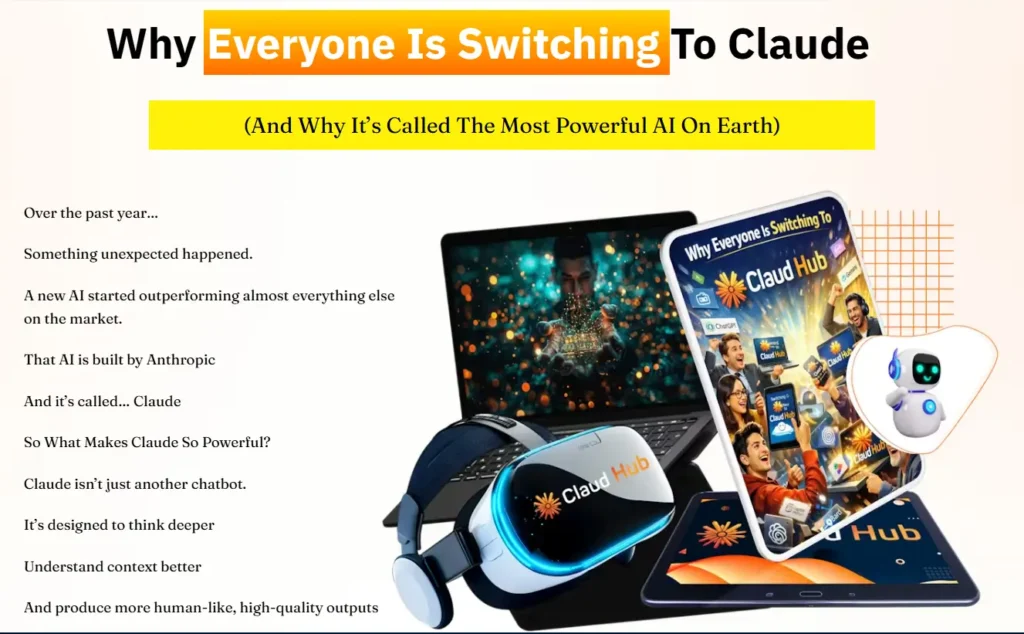
How ClaudHub Actually Works — Step by Step
Here’s a clear walkthrough of what happens when you use the product:
Step 1 — Log in to your dashboard. After purchasing, you receive credentials to Claud Hub’s web platform. No software to install; it runs entirely in your browser.
Step 2 — Choose your Claude model. You select from the available Claude models: Haiku (fastest, most economical), Sonnet (balanced quality and speed), or Opus (highest reasoning, slowest). Each is suited to different tasks.
Step 3 — Choose a prompt template or write your own. The built-in prompt library has pre-built templates for common tasks. You can fill in variables (product name, target audience, tone) and generate immediately — no prompt engineering knowledge required.
Step 4 — Review, refine, and export. The output appears in the central panel. You can request refinements, switch models to compare, and copy the result into your workflow. There’s no built-in publishing integration; you manually copy outputs.
As noted in this Claud Hub Review, what’s happening behind the scenes is a call to Anthropic’s Claude API. Your prompts are sent to Anthropic’s servers, processed by Claude, and returned. The “magic” is the dashboard layer that makes this accessible without technical knowledge.
Mini use-case scenario: A freelance copywriter needs 10 Facebook ad variations for a client’s product. Without Claud Hub, they’d need to know how to prompt Claude effectively — which takes practice. With Claud Hub, they load the “Facebook Ad” template, enter the product details, and generate 10 variations in under 10 minutes. The quality depends entirely on how good Claude is at this task (very good), not on anything Claud Hub adds technically.
Key Features — Explained With Real Impact (ClaudHub Review)
1. Multi-Model Switching
What it is: The ability to switch between Claude Haiku, Sonnet, and Opus without managing separate API keys or settings. Why it matters: Different tasks need different models. A simple email draft doesn’t need Claude Opus — Haiku is faster and cheaper. A complex business strategy might need Opus. Understanding this distinction helps you work smarter. Real example: Generating 50 social media captions → Haiku. Writing a detailed competitive analysis → Opus.
2. Built-In Prompt Library
What it is: Pre-written, tested prompts for sales copy, emails, ad scripts, blog posts, and more. Why it matters: Prompt engineering is a real skill with a real learning curve. Good prompts produce dramatically better outputs. For beginners who haven’t developed this skill yet, quality templates genuinely accelerate results. Limitation: These prompts are fixed templates — experienced users will likely outgrow them quickly.
3. Side-by-Side Output Comparison
What it is: Generate the same prompt across two models and view outputs simultaneously. Why it matters: This is genuinely rare in Claude interfaces. It helps users develop intuition about model strengths and teaches you when Opus justifies its higher cost versus Sonnet.
4. Commercial License
What it is: Permission to use outputs for client work and keep all profits. Why it matters: This is standard for AI tool content, but having it explicitly stated matters for freelancers billing clients. It removes legal ambiguity for those new to the space.
5. OTO-3: Voiceover & Image Generation
What it is: Additional creative tools — text-to-speech voiceover and AI image generation. Important caveat: These are not Claude features. Anthropic doesn’t offer image generation or voiceovers. These features use separate third-party APIs (likely ElevenLabs or similar for voice; Stability AI or similar for images). Their quality and availability depend on those third-party services, not Claud Hub or Anthropic.
Who Is Claud Hub Actually For?
Based on this Claud Hub Review analysis, here are the three profiles who will genuinely benefit:
Profile 1: The Complete AI Beginner
You’ve heard about Claude and ChatGPT but feel overwhelmed by blank chat interfaces. You’re not sure how to write a good prompt, and you need hand-holding through the process. The template library and simple dashboard reduce the “blank page” problem significantly. You’ll get immediate results without needing to learn prompt engineering from scratch.
Profile 2: The Time-Pressed Solopreneur
You run a small business or freelance operation and need to produce marketing content regularly — but content creation isn’t your primary skill or interest. You want a fast, reliable way to generate decent copy quickly. Claud Hub’s one-click prompt execution genuinely speeds up this workflow compared to manually crafting prompts each time.
Profile 3: The Aspiring Freelance Copywriter
You’re building a service offering around AI-assisted content creation for clients. The commercial license explicitly covers client work, the prompt templates give you a starting structure, and the model variety lets you match output quality to client budget. The included “Financial Freedom” OTO (with caveats) also provides a framework for packaging and selling these services.
Who Should NOT Use Claud Hub — Trust Builder
1. Existing Claude.ai subscribers. If you already have a claude.ai Pro account, you have direct access to the same models with the same quality. Adding Claud Hub is paying for a layer of convenience on top of something you already own. Better to invest that money in learning prompt engineering.
2. Developers or technically-minded users. If you’re comfortable with APIs or have used Claude directly, Claud Hub’s interface will feel restrictive and its templates will feel generic. You can build a more powerful, customized workflow using Claude’s API directly at lower cost.
3. Enterprise or professional teams. Professional content and marketing teams need reliability guarantees, data privacy documentation, and enterprise-grade SLAs that a third-party wrapper product cannot provide. Anthropic’s direct enterprise offering is the right path here.
Pros and Cons — Honest Breakdown (ClaudHub Review)
✓ Pros
- Genuinely beginner-friendly. The clean interface and pre-built templates significantly reduce the learning curve for new AI users who don’t know how to prompt effectively yet.
- Multi-model switching in one place. Accessing Haiku, Sonnet, and Opus from a single dashboard — with comparison view — is a feature that even Claude.ai’s own interface handles less elegantly.
- Commercial license included. For freelancers, having explicit written permission to use outputs for paying clients removes an important legal grey area for early-stage service providers.
- Prompt library saves real time. For recurring marketing tasks (email sequences, ad copy, social posts), ready-made templates eliminate repetitive prompt writing and deliver consistent results.
- No technical setup required. Browser-based, no API keys to configure, no developer knowledge needed. Genuinely accessible to non-technical users from day one.
✗ Cons
- “Lifetime access” claim is misleading. Anthropic’s Claude API has ongoing costs that must be paid to keep the service running. “No monthly fees, forever” is not a sustainable model and could change. This is a significant trust issue. Not a dealbreaker if you go in with eyes open, but needs to be understood.
- You’re paying a middleman for something you can access directly. Claude.ai Pro at $20/month gives you the same underlying models, often with more features. Claud Hub is a convenience layer, not a capability upgrade.
- OTO stack is aggressive. Ten upsells is a red flag for product longevity and support quality. Products with this many upsells often prioritize launch revenue over long-term user satisfaction. Minor con for informed buyers, potentially major for impulse buyers.
- Third-party APIs in OTO-3 add hidden dependency. Image and voiceover features depend on external providers. If those providers raise prices or go offline, those features break — and Claud Hub has no control over that.
Red Flags & Realistic Expectations
What this product will NOT do:
- It will not generate income automatically — content creation requires distribution, editing, and marketing strategy that no tool provides.
- It will not give you a permanent free pass to Claude’s most powerful models — API costs exist and will be managed by the provider.
- It will not replace skill development — the better you understand marketing and copywriting, the better your AI outputs will be, regardless of the tool.
- It will not outperform direct Claude.ai access in raw capability — it is a UI layer, not an intelligence enhancement.
Common misconceptions: Many buyers assume “Claude Opus access included” means enterprise-level unlimited usage equivalent to Anthropic’s $200/month Max plan. It does not. Usage limits exist; the specifics should be confirmed with the vendor before purchasing.
Realistic timeline: If you use the template library consistently for content creation tasks, you can expect to save 2–4 hours per week on prompt writing within the first two weeks. Meaningful revenue impact from that time saving depends entirely on what you do with it.
Pricing & Value Analysis
When evaluating this Claud Hub Review from a pricing perspective, here is the full funnel breakdown as disclosed in the JV materials:
One-time
The important context in this Claud Hub Review: to get “unlimited” usage (OTO-1 is effectively required for heavy users) and the full creative suite (OTO-3), the total investment can climb significantly above the frontend price. Compare this against Claude.ai Pro at $20/month — after 6 months, that’s $120, which provides direct, guaranteed, regularly updated access to the same underlying models with Anthropic’s full support and infrastructure. After 12 months, Claude.ai Pro totals $240, which is roughly comparable to a fully-loaded Claud Hub funnel — but with more certainty about continued access.
Money-Back Guarantee & Risk Reversal
Claud Hub offers a 30-day money-back guarantee on purchases made through its launch platform. This means that if you purchase the frontend product and decide within 30 days that it isn’t delivering value for your situation, you can request a full refund through the support desk at tickets@hyper-softlabs.p.tawk.email. The process is standard for WarriorPlus/LaunchPad products: submit a ticket, state your reason, and the refund is processed typically within 5–7 business days.
It’s worth understanding what this guarantee actually covers. The 30-day window starts from the date of purchase — not the date you first log in or actively start using the product. If you buy during the launch and don’t get around to testing it until week 3, your refund window is already partially elapsed. The guarantee covers the original purchase price; conditions for refunds on upsells should be confirmed independently with the support desk before purchasing OTOs.
Why does this guarantee matter? It means you can try Claud Hub with real tasks during the first month without financial risk. If the template library doesn’t save you meaningful time, or if the interface doesn’t suit your workflow, or if you simply find that claude.ai works better for you directly — you can exit with your money intact. The existence of a money-back guarantee reflects a degree of confidence from the creators that the product delivers on its core promises. Your investment is protected during the evaluation window. This removes the largest barrier to trying the product: the fear of wasting money on something that doesn’t work for you.

30-day money-back guarantee means you can test Claud Hub with your actual workflow before fully committing. If it doesn’t deliver time savings or useful outputs within 30 days, request a refund.
Can Claud Hub Actually Deliver Results?
The honest answer is: it depends entirely on what “results” means for you. If results mean “generating more content faster than I could without AI” — yes, Claud Hub delivers that. The same Claude models that power professional-grade content creation are accessible through this dashboard, and the prompt templates ensure that even inexperienced users produce decent outputs from day one.
The factors that determine your success: (1) How frequently you use it. AI tools only save time if you actually use them consistently. A dashboard that takes 30 seconds to open and requires no prompt knowledge removes friction — which increases the likelihood of consistent use. (2) What you do with the outputs. Claude can write a sales email, but whether that email converts depends on your offer, your list quality, and your market positioning. (3) Whether you invest in the right OTOs. The frontend alone is functional but limited. The unlimited edition (OTO-1) is effectively required for anyone generating significant content volume.
Who gets the best results: absolute beginners who commit to using the tool daily for 30 days, freelancers with an existing client base who can immediately apply outputs to paid work, and content creators with distribution channels who can publish AI-assisted content regularly.
Who struggles: users who buy expecting the tool to do everything without input, or those who have already developed strong Claude prompting skills and find the templates too generic for their needs.
Claud Hub vs. Direct Claude.ai — Fair Comparison
| Factor | Claud Hub | Claude.ai Pro (Direct) |
|---|---|---|
| Underlying AI quality | Same Claude models | Same Claude models (direct) |
| Pricing model | One-time + upsells | $20/month, clear and predictable |
| Prompt templates | Pre-built library included | Manual (or community sourced) |
| Model switching UX | Side-by-side comparison | Single model per conversation |
| Long-term reliability | Depends on vendor sustainability | Direct from Anthropic |
| Data privacy | Third-party data handling | Anthropic directly |
| Future model updates | Claimed, not guaranteed | Automatic, guaranteed |
| Best for | Absolute beginners | Intermediate to advanced users |
In this Claud Hub Review comparison, the clear verdict is: Claude.ai Pro wins on reliability and long-term value; Claud Hub wins on beginner accessibility and template convenience. If you’re a beginner who wants to start using Claude immediately without learning prompt writing — and you understand the limitation around “lifetime access” claims — Claud Hub has genuine utility for your current stage.
How to Use Claude AI Effectively — Even Without Claud Hub
Whether or not you purchase Claud Hub, here is a practical framework for getting excellent results from Claude AI directly. This is genuine value regardless of your purchasing decision:
The 4-Part Prompt Framework:
- Role: Tell Claude who it is. “You are an expert direct-response copywriter with 15 years of experience.”
- Context: Explain the situation. “I’m writing a sales email for a $97 online course teaching freelance web design to beginners.”
- Task: Be specific about what you need. “Write a 200-word email subject line and body with a single CTA to a free webinar.”
- Constraints: Define tone and limits. “Use conversational language, no jargon, avoid hype, end with a simple question.”
This four-part structure replicates what Claud Hub’s best templates do automatically — but once you’ve internalized it, you can apply it to any task in any context, faster than loading a template. Practice this with 10 different tasks and within a week, your output quality will equal or exceed what any template library produces. The skill compounds over time; template dependency does not.
Model selection guide: Use Haiku for short, simple tasks (social captions, bullet points, quick rewrites). Use Sonnet for standard marketing content (emails, blog posts, scripts). Use Opus only for complex analytical tasks (competitive research, detailed strategy documents, multi-step reasoning). This keeps your usage efficient whether you’re using Claud Hub or claude.ai directly.
Bonuses
Claud Hub comes with a set of additional bonuses including done-for-you offer templates, VIP bonus materials (linked in the JV page), reseller resource documents, and access to future OTO features as they’re released. The total stated bonus value on the sales page is significant — but as with all product launches, bonuses are most valuable when they complement something you actually need rather than padding perceived value. Review the bonus list carefully against your specific workflow needs before purchasing.
Frequently Asked Questions
Is Claud Hub the same as Claude.ai? What’s actually different?
No — and this is one of the most important distinctions to understand before purchasing. Claude.ai is Anthropic’s official product, built and maintained directly by the company that created the Claude AI models. Claud Hub (note the missing “e”) is a third-party application created by an independent team that uses Anthropic’s publicly available API to power its interface. The underlying AI is the same — Claude Opus, Sonnet, and Haiku models — but the way you access it, the interface you use, and the company responsible for your account are completely different. When you use Claude.ai, your data is governed by Anthropic’s privacy policy and your access is guaranteed by Anthropic. When you use Claud Hub, you’re trusting a third-party vendor with your usage and data, and your continued access depends on that vendor maintaining their API agreements with Anthropic. For most beginner users, this distinction doesn’t cause day-to-day problems — but it’s important for making a fully informed decision, especially regarding data privacy and long-term service reliability. This Claud Hub Review strongly recommends reading both privacy policies before deciding which route to take.
Is the “lifetime access, no monthly fees” claim in this Claud Hub Review actually true?
This is the most important question in this Claud Hub Review, and it deserves a fully honest answer. The “no monthly fees” and “lifetime access” claims are marketing language that requires significant qualification. Anthropic charges for Claude API usage on an ongoing basis — the models don’t run for free. For Claud Hub to sustain its “one-time payment” model, the company either (a) absorbs API costs from their margin, which is only sustainable up to a volume limit, (b) imposes usage limits that keep per-user costs low (making “unlimited” claims misleading), or (c) builds in usage caps that aren’t prominently disclosed. None of these scenarios guarantees uninterrupted, truly unlimited lifetime access. Compare this to Claude.ai Pro: at $20/month, Anthropic directly guarantees your access for as long as you pay, with clear pricing and documented usage limits. The “one-time payment” framing of Claud Hub is appealing but introduces uncertainty that a direct subscription does not. For context: many similar “lifetime access” AI tools launched in 2023–2024 have since changed their pricing, added credits systems, or shut down. This doesn’t mean Claud Hub will — but buyers should go in with clear expectations rather than assuming perpetual unlimited access.
Who are the creators of Claud Hub, and are they credible?
Claud Hub was developed by Hyper Soft Labs, a team headed by Amit Gaikwad and Anirudh Baavra. They are active in the WarriorPlus and LaunchPad product launch ecosystem — a space focused on digital marketing tool releases. They have launched previous products in this space and have a track record in the affiliate/internet marketing community. Their products generally follow the standard JV launch structure: a frontend product with multiple upsells, affiliate contest prizes to drive promotion, and email-list-based marketing. This context is neither inherently positive nor negative — many legitimate tools are launched this way. It does mean, however, that product support quality and longevity can vary, and that the launch-week experience may differ from the long-term product experience. Checking for support responsiveness before or shortly after purchase is wise. For this Claud Hub Review, I found the team contactable via Teams and WhatsApp, which suggests at least basic responsiveness during the active launch window.
Do I need to buy all the OTOs to get value from Claud Hub?
Not all of them — but some are more functional than optional. The frontend alone provides the core dashboard, model switching, prompt library, and commercial license. For light, occasional users exploring AI for the first time, the frontend is sufficient to evaluate whether the tool fits your workflow. However, if you intend to use Claud Hub for regular content production, OTO-1 (Unlimited Edition) is effectively necessary — the base tier’s usage limits will become a friction point relatively quickly. OTO-2 (DFY Edition) adds genuine value for users who want a wider template library and an AI editor/rewriter, particularly for blog content and social media. OTO-3 (Creative Studio) is only worth it if you specifically need voiceovers or AI images — and you should be aware these depend on separate third-party services. OTO-4 through OTO-10 are progressively more specialized and are primarily relevant to users building an agency or service business around the tool. Buying the full funnel without a clear use case for each OTO is not recommended — it’s a significant additional investment for features most individual users won’t fully utilize.
What results can I realistically expect from Claud Hub in the first 30 days?
In the first 30 days, realistic expectations for this Claud Hub Review are: you will be able to generate useful marketing content faster than you could manually or without AI experience. If you use the prompt templates daily for your specific tasks — whether that’s email writing, social media captions, ad copy, or blog drafts — you can expect to save 2–5 hours per week compared to writing from scratch. For a freelancer billing hourly, that time saving has direct financial value. For a business owner, it means more content output with the same effort. What you should not expect: immediate revenue, passive income generation, or outputs that require no editing. AI-generated content from Claude is high quality but not plug-and-play perfect for every context. Plan to spend 10–20% of total content time on editing and personalizing outputs. The best results come from users who treat Claud Hub as a first-draft accelerator, not a finished-content generator. Combine it with your own industry knowledge and audience understanding, and the quality of what you produce will be significantly higher than generic AI output alone.
Is Claud Hub Review worth it compared to just getting Claude.ai directly?
This Claud Hub Review concludes that the answer depends entirely on where you are in your AI learning journey. If you have zero experience with AI prompting and want immediate, guided results without a learning curve — Claud Hub’s template library and clean interface provide real value during your beginner phase. The one-time pricing structure may feel more comfortable than an ongoing monthly commitment. However, if you’re already comfortable with AI tools or willing to spend 1–2 weeks learning basic prompt techniques, Claude.ai Pro at $20/month delivers more reliability, better long-term value, and direct access without a middleman. The technical experience with Claud Hub is identical in output quality to claude.ai Pro — because it’s the same Claude — but the “lifetime, no fees” framing introduces uncertainty that doesn’t exist with a direct Anthropic subscription. Our recommendation: if you’re a complete beginner with a limited budget and want to try AI content creation now, Claud Hub’s 30-day guarantee makes it a low-risk experiment. If you’re already past the absolute beginner stage, claude.ai Pro is the cleaner, more reliable choice.
Final Verdict — Claud Hub Review
Overall Rating
Claud Hub is a functional, beginner-friendly dashboard for Claude AI. It delivers on its interface and template promises — but its “lifetime access, no fees” marketing overstates sustainability, and the ten-upsell funnel structure reduces confidence in long-term product focus.
After conducting this full Claud Hub Review, here’s the clear-eyed conclusion: Claud Hub is a legitimate beginner tool with a misleading marketing angle. The core product — a clean Claude dashboard with ready-made prompt templates and model switching — genuinely works and provides real value for users at the start of their AI journey. The problem is the “lifetime access with no monthly fees” claim, which misrepresents the underlying economics and sets expectations that are unlikely to hold long-term without undisclosed conditions.
Who should buy: Complete beginners who have never used Claude, want immediate results without learning prompting, and are comfortable with the 30-day guarantee as their safety net. Freelancers who need a commercial license and template starting points for client work. Users who find the claude.ai interface intimidating and want a more guided experience.
Who should skip: Anyone already using Claude.ai or another AI tool confidently. Developers or technical users. Long-term thinkers who want to build AI skills that compound. Anyone who will stress about the “is this actually lifetime?” question — because that uncertainty is real. For these readers, this Claud Hub Review recommends claude.ai Pro as the cleaner, more honest alternative.
If content creation is stealing hours from your week, and you’ve been putting off using AI because it feels complicated — Claud Hub removes exactly that barrier. You don’t need to know how to prompt. You don’t need a technical background. You open the dashboard, pick a template, and get a usable first draft in 60 seconds. And if, after 30 days, it hasn’t saved you meaningful time or delivered useful outputs — the money-back guarantee means you haven’t lost anything except the time to test it.
The question isn’t whether Claude AI can produce good marketing content — it absolutely can. The question is whether Claud Hub’s dashboard is the right entry point for where you are right now. If you’re a beginner who wants to start today, it might be.
Affiliate Disclosure:
This article may contain affiliate links. If you purchase through these links, I may earn a small commission at no extra cost to you. This does not influence this review — all opinions are based on genuine evaluation of the product’s features, claims, and market alternatives.